Primary Datum
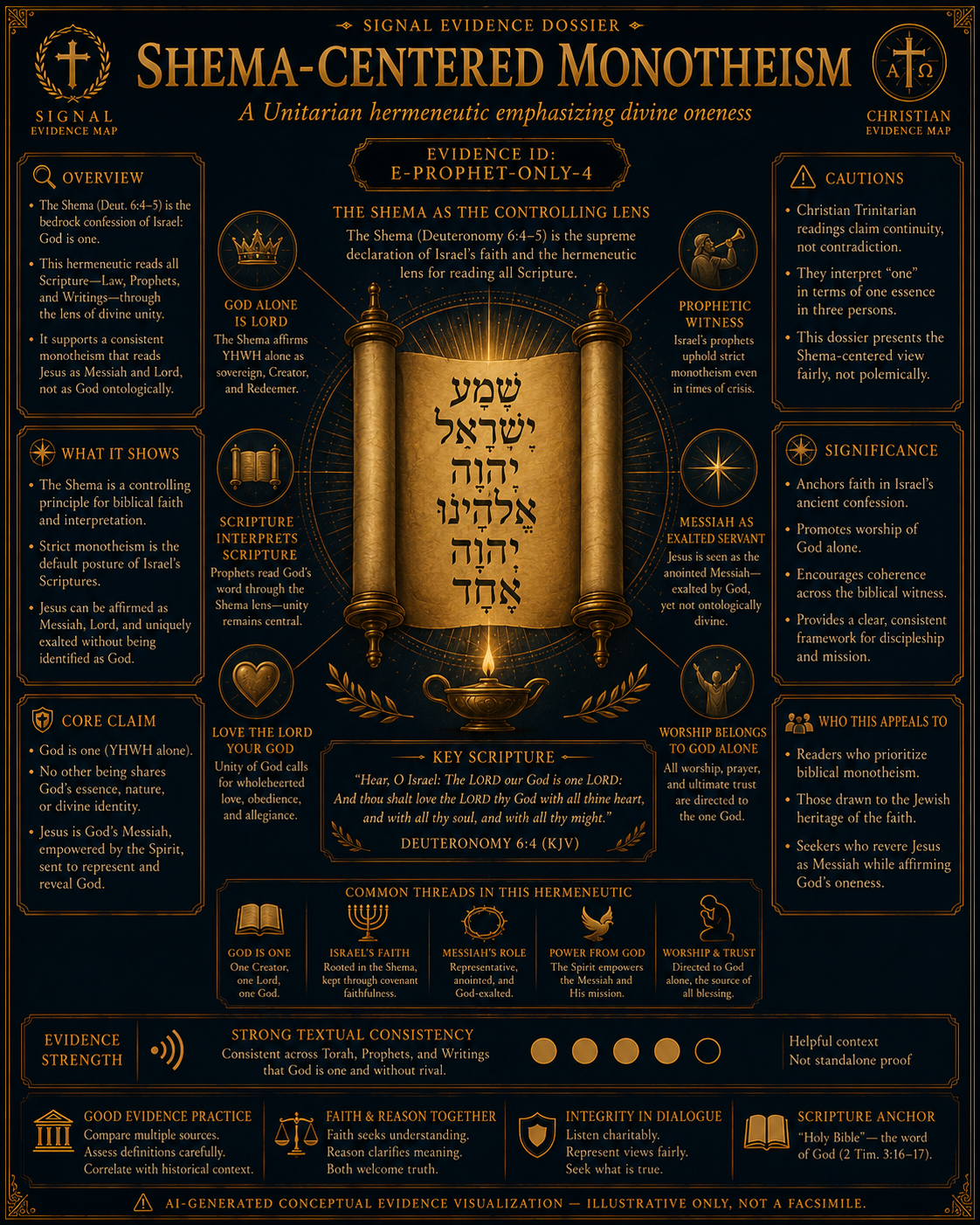
Datum: a strict Shema-centered hermeneutic reads Christological titles as functional roles rather than divine identity claims.
Scoring / Hypothesis Pressure
Contextual / unweighted / no active Bayes factor.
Dependency / Cap Metadata
- dependency_cluster_id
- christ_identity_rival_pressure
- dependency_cluster_role
- duplicate_context
- dependency_cluster
- christ_identity_rival_pressure
- dependency_role
- duplicate_context
- cap_profile
- exact_duplicate
- evidence_function
- unweighted_explanatory
- directness
- explanatory_only
Counter-Pressure
- title
- The Shema is the doorway, not the dead end.
- text
- Christianity must never answer Jewish monotheism by smuggling in a second god. The Shema is not the enemy of the Christian claim; it is the room in which the claim must stand. The New Testament pressure is that Jesus is not merely placed near God as a useful agent. He is drawn into God's rule, judgment, name, worship, and saving action. That is costly language, but it is not casual polytheism.
- path
- Begin with the one God of Israel and mean it. Then ask what the earliest Christians believed had happened in Jesus: sins forgiven, the dead raised, the Son of Man enthroned, the risen Lord worshiped, and God's identity confessed through Father, Son, and Spirit. The prophet-only reading must explain why strict monotheists crossed that line so early.
Apologetic Note
- label
- Apologetic leverage
- title
- Scripture is strongest when context and fulfillment stay together.
- key point
- Unitarian hermeneutic: Shema-centered monotheism should not be handled like a magic verse. Good apologetics reads the original setting first, then asks why so many lines of Scripture converge on Christ.
- conversation move
- Say to a teenager: do not rip verses out of context, but do not ignore the pattern either. King, servant, temple, sacrifice, wisdom, covenant, exile, nations, and kingdom all start pointing toward Jesus.
- caveat
- Do not pretend rival readings are stupid. The Christian claim is that Christ makes the whole story cohere, not that every verse is obvious in isolation.
Scripture Passage
reference: Deuteronomy 6:4
Caveats / Notes
- Cap notes
- This row preserves rival pressure against Christ Identity overstatement. Future cap diagnostics may govern overlap with sibling rival rows, but should not hide the objection.
- Cap profile note
- Hidden/merged duplicate rows must not stack if reactivated without review.
- Cluster note
- Strict-monotheism cap: supports Judaism/Islam or prophet-only readings only modestly, and is capped against overlapping Scripture/Text monotheism and non-fulfillment rows.
- Scoring note
- Prophet-only / strict monotheism comparator. Modest Judaism/Islam-positive and Christianity-counter score; capped by broader Christology evidence.
- Governance note
- Merged into E-STRICT-UNITY-NONTRINITARIAN-ANCHOR as duplicate Shema/strict-unity pressure.
Machine-Readable Source
This page is generated from the public evidence mirror without recalculating or changing scores.