Primary Datum
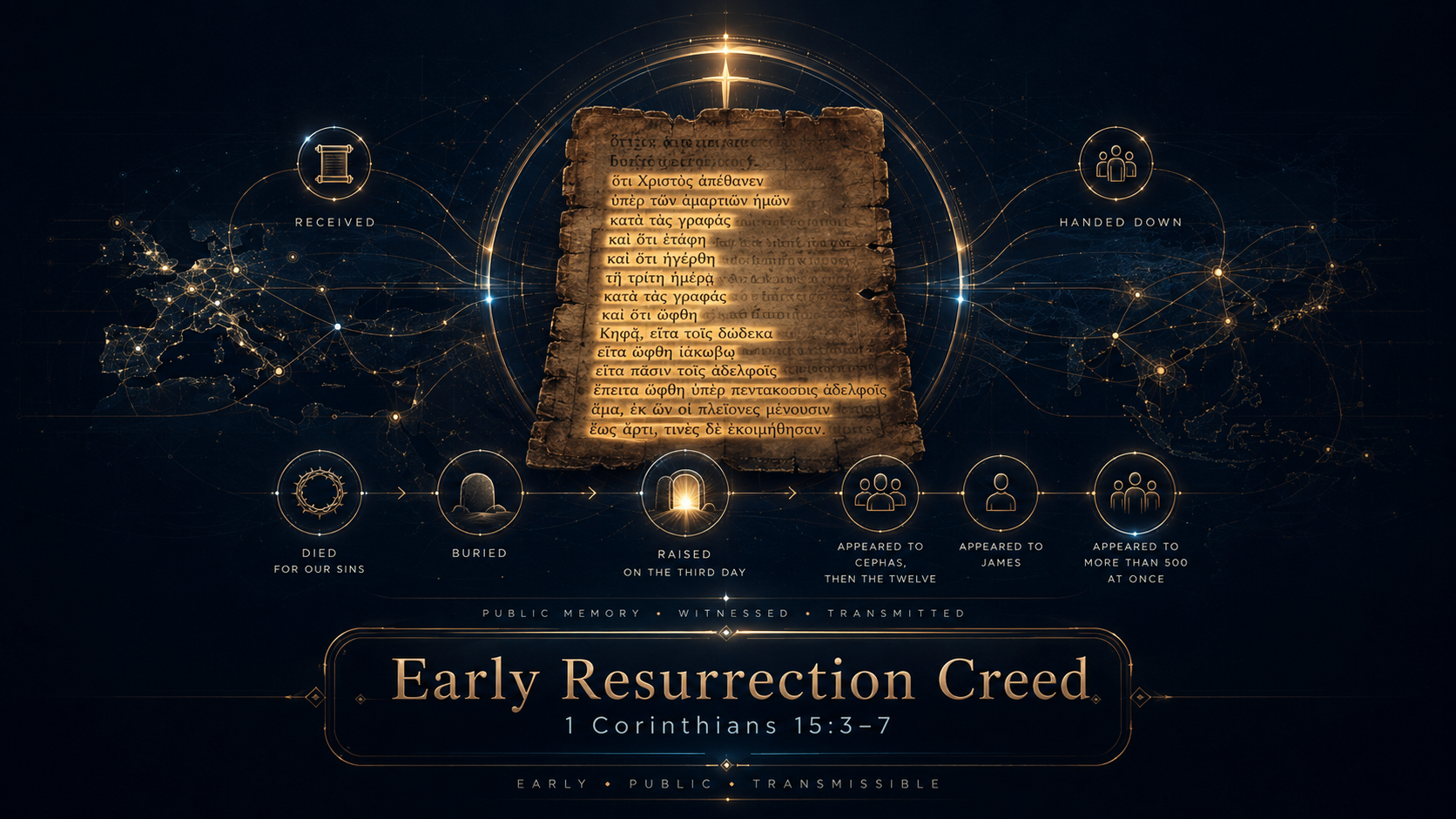
Datum: An early creed embedded in 1 Corinthians 15:3-7 summarizes Jesus' death, burial, resurrection, and appearances.
Dependency / Cap Metadata
- dependency_cluster_id
- pauline_high_christology
- dependency_cluster_role
- primary_anchor
- dependency_cluster
- resurrection_witness_structure
- dependency_role
- anchor
- cap_profile
- moderate_semi_independent
- evidence_function
- direct_event
- directness
- direct
Counter-Pressure
- title
- Early Resurrection Creed (1 Cor 15:3-7) is a bounded signal, not a standalone proof.
- text
- The strongest caution is overuse. No one Pauline row proves the full doctrine of the Trinity by itself. This row should be read inside its dependency family, not treated as an isolated demonstration of God, Christ, or the final synthesis.
- path
- Start with what the row actually shows, then name what it does not show. Use it with Shema, YHWH-text, devotion, and Resurrection rows to ask how early Christ-centered identity emerged.
Apologetic Note
- label
- Apologetic leverage
- title
- The creed asks what could make devout Jews reorganize worship around a crucified Messiah.
- key point
- 1 Corinthians 15 is early, compact, and Jewish. It is not a loose spiritual rumor from random seekers; it is a handed-on proclamation that death, burial, resurrection, and appearances belonged to the message from the beginning. The force is the social and theological cost: devout Jews, including Paul the former persecutor and James in Jerusalem, came to treat Jesus' resurrection as the decisive act of Israel's God.
- conversation move
- Put the conversion burden in ordinary terms. Ask what would make people with a thick inherited faith, Scripture, worship, purity boundaries, and communal costs publicly re-center allegiance on the crucified Jesus. People can change religions, but this kind of reversal needs a cause large enough to explain the creed, the witnesses, the mission, and the worship.
- caveat
- Do not say the creed alone proves the Resurrection. Say it sharply limits lazy late-legend accounts and forces rival theories to explain early public proclamation among highly religious Jews, alongside Paul, James, Jerusalem, costly witness, and the wider resurrection field.
Scripture Passage
label: Early creed summary; reference: 1 Corinthians 15:3-7
Caveats / Notes
- Source note
- Canonical early creed citations are restricted to primary Pauline text, adjacent Pauline witness context, and directly relevant early-resurrection / early-Christology scholarship. Background and analogy sources must not be treated as direct support.
- Cap notes
- This row belongs to the Christ Identity / early high Christology family. It supports Christ-specific evidence and should be assessed with related early devotion and witness rows.
- Cap profile note
- Semi-independent convergence rows are capped, but not treated as exact duplicates.
- Cluster note
- Canonical primary early creed anchor. Direct H-RESURRECTION scoring should be concentrated here and in clearly event-level rows; duplicate creed rows remain unscored.
- Scoring note
- Canonical primary early creed anchor. Direct H-RESURRECTION scoring should be concentrated here and in clearly event-level rows; duplicate creed rows remain unscored.
- Governance note
- Canonical creed anchor; duplicate creed rows remain unscored/context.
Machine-Readable Source
This page is generated from the public evidence mirror without recalculating or changing scores.