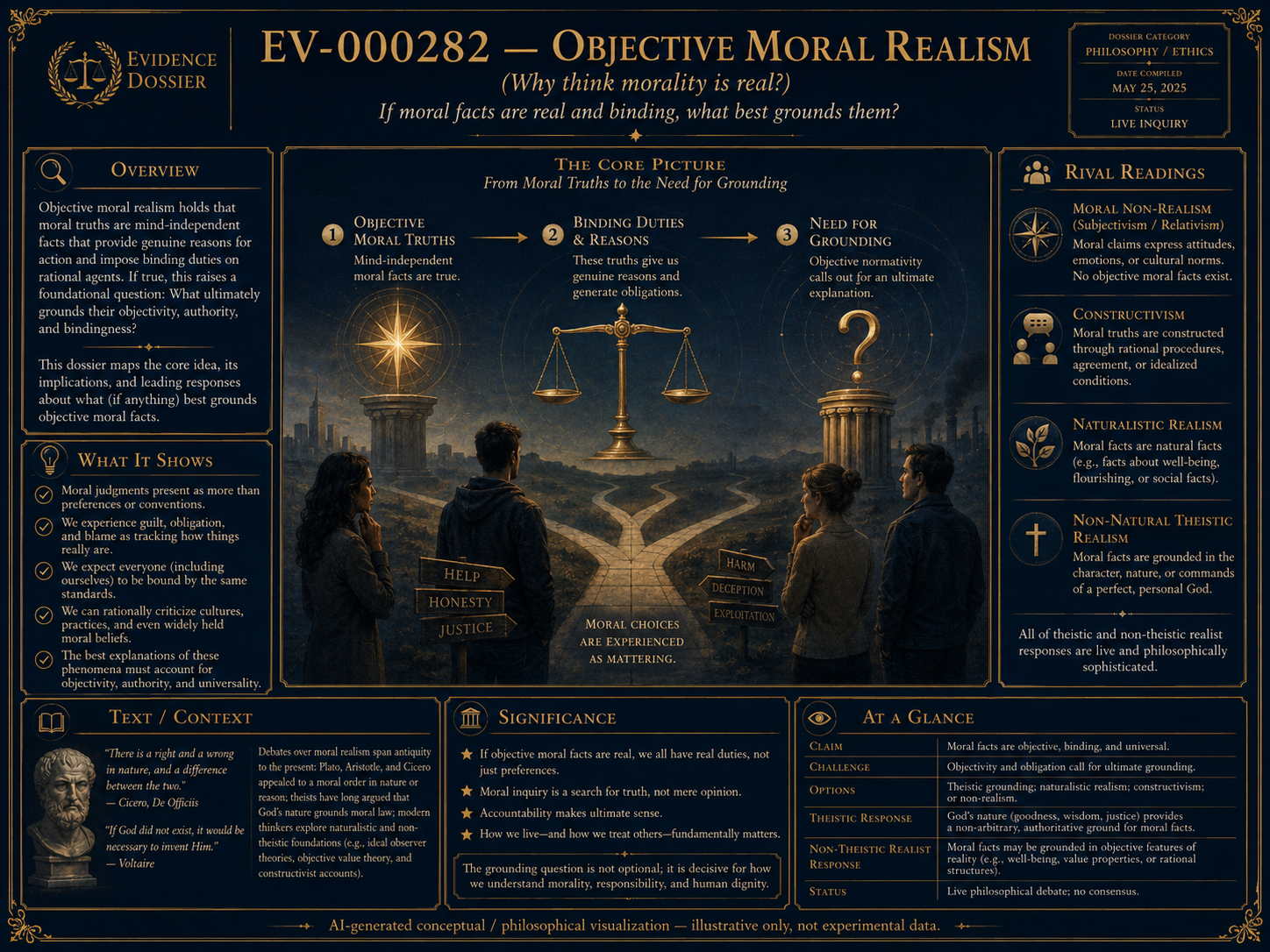
Primary Datum
Datum: humans widely experience moral truth, conscience, obligation, dignity, and moral knowledge as more than preference.
Dependency / Cap Metadata
- dependency_cluster_id
- morality_personhood
- dependency_cluster_role
- primary_anchor
- dependency_cluster
- morality_personhood
- dependency_role
- primary_anchor
- cap_profile
- moderate_semi_independent
- evidence_function
- context_child
- directness
- supporting
Counter-Pressure
- title
- Objective Moral Realism (Why think morality is real?) is a bounded signal, not a standalone proof.
- text
- The strongest caution is overuse. This does not prove Christianity by itself, and secular moral realists deserve a fair hearing. This row should be read inside its dependency family, not treated as an isolated demonstration of God, Christ, or the final synthesis.
- path
- Start with what the row actually shows, then name what it does not show. Use it to ask what kind of reality can make moral duties genuinely binding.
Apologetic Note
- label
- Bounded positive signal
- title
- Objective Moral Realism (Why think morality is real?) sounds stronger than taste.
- key point
- Humans widely experience certain moral truths as objectively binding, not merely as personal preferences. The clue is that moral claims feel discovered and binding, not merely preferred, useful, or socially fashionable.
- conversation move
- Make the distinction gently: atheists can be deeply moral; the question is what kind of world makes moral obligation, guilt, dignity, and sacrificial love objectively real.
- caveat
- Treat this as a bounded positive signal: it gives real help to the Christian map while leaving live pressure for the wider case. Do not weaponize morality. The positive signal is explanatory fit, not personal superiority.
Scripture Passage
Isaiah 61:1-2; Exodus 34:6-7; Psalm 136; Hosea 11:1-9
Caveats / Notes
- Source note
- Citation list curated from a polluted broad-source list. Active BF values unchanged; conscience, obligation, dignity/personhood, moral knowledge, and debunking objections remain governed inside this anchor.
- Cap notes
- This row is the governed moral realism and personhood anchor. Conscience, obligation, dignity, and moral knowledge belong inside this anchor and should not be split into independent score rows without review.
- Cap profile note
- Semi-independent convergence rows are capped, but not treated as exact duplicates.
- Cluster note
- Moral-realism cap: moral data enters downstream comparison, not Signal Core axioms, and should not stack freely with relationality or reason rows.
- Governance note
- Citation list curated to moral realism, theistic grounding, non-theistic realism, evolutionary debunking/moral psychology, and relevant primary Scripture texts. Active BF values unchanged.
Machine-Readable Source
This page is generated from the public evidence mirror without recalculating or changing scores.