Primary Datum
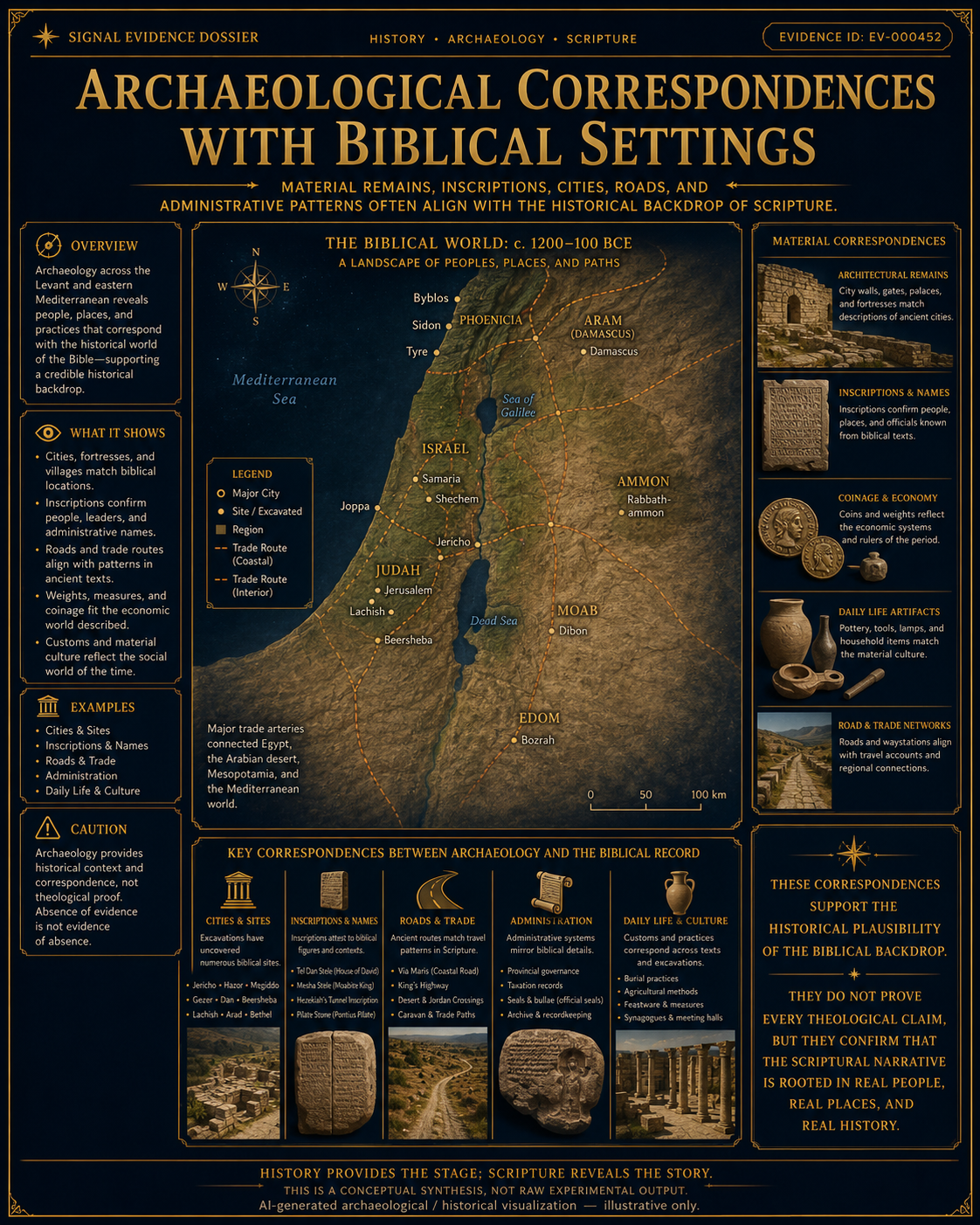
Datum: inscriptions, sites, and material-culture correspondences can support biblical historical embeddedness as backdrop evidence.
Dependency / Cap Metadata
- dependency_cluster_id
- material_culture_synthesis_support
- dependency_cluster_role
- support_layer
- dependency_cluster
- material_culture_synthesis_support
- dependency_role
- support_layer
- cap_profile
- support_layer_small
- evidence_function
- support_layer
- directness
- supporting
Counter-Pressure
- title
- Archaeological correspondences with biblical settings (backdrop) is a bounded signal, not a standalone proof.
- text
- The strongest caution is overuse. Textual reliability is not identical to theological truth, and variants must be handled openly. This row should be read inside its dependency family, not treated as an isolated demonstration of God, Christ, or the final synthesis.
- path
- Start with what the row actually shows, then name what it does not show. Use it to show that the textual base is not arbitrary, while leaving historical and theological claims to their own rows.
Apologetic Note
- label
- Apologetic leverage
- title
- Archaeological correspondences with biblical settings (backdrop) shows a field of meaning, not one trick verse.
- key point
- A family of inscriptions, sites, and material-culture synchronisms can show that biblical narratives preserve real names, offices, places, or local settings. The apologetic leverage is the breadth of the pattern: covenant, exile, restoration, temple, sacrifice, wisdom, kingdom, and Messiah drawing toward Christ.
- conversation move
- Invite the listener to step back from isolated verses and look at the whole architecture. A worldview should explain why the pieces belong together, not merely explain them away one by one.
- caveat
- Do not confuse coherence with coercion. Canonical pattern supports the case without forcing certainty from any one row.
Caveats / Notes
- Source note
- Prior fine-tuning/source placeholders replaced with sources matching archaeological/textual embeddedness; concrete examples should be tied to dedicated item-level evidence before scoring.
- Cap notes
- Support-only child under SYN-MAT-CULT; not a direct Christ-identity proof.
- Cap profile note
- Support-layer rows stay small even when visible and inspectable.
- Cluster note
- Support-layer row only. Does not imply Christology, resurrection, miracles, inerrancy, or full narrative reliability; capped against concrete archaeology/textual rows.
- Scoring note
- No Bayes factors applied. Specific archaeological/topographical items should carry concrete weights to avoid duplicate umbrella scoring.
- Governance note
- Capped as material-culture support under SYN-MAT-CULT.
- Disposition note
- Batch 2 full-item completion: clarified as umbrella Scripture/Text backdrop evidence. Needs textual/historical reliability or Scripture-embeddedness hypothesis seat before any BF review; do not score as direct Christology or resurrection evidence.
Machine-Readable Source
This page is generated from the public evidence mirror without recalculating or changing scores.