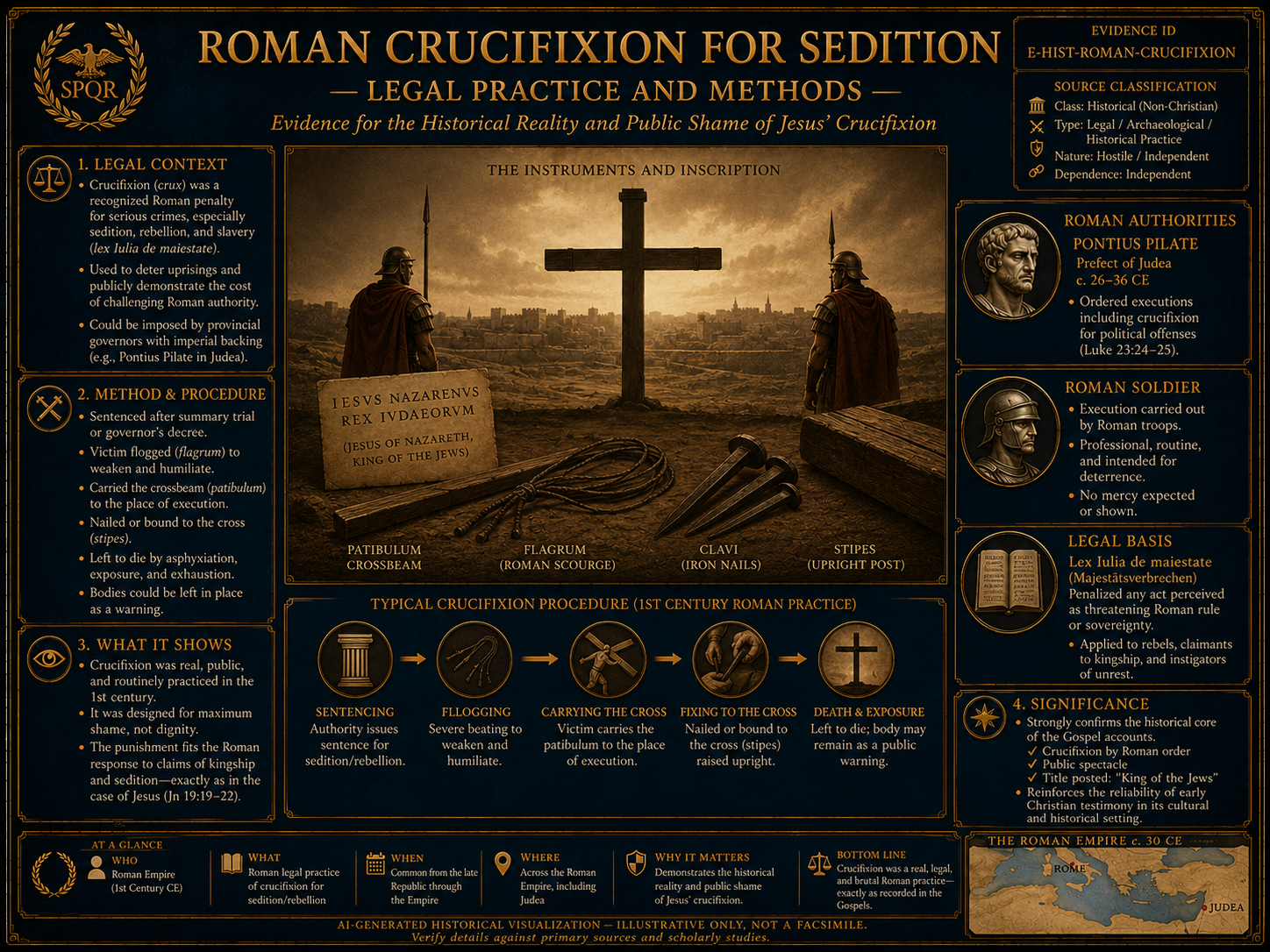
Primary Datum
Datum: Crucifixion was a standard Roman penalty for slaves and rebels, used as a public, deterrent spectacle.
Dependency / Cap Metadata
- dependency_cluster_id
- empty_tomb_burial
- dependency_cluster_role
- sibling_support
- dependency_cluster
- empty_tomb_burial
- dependency_role
- sibling_support
- cap_profile
- moderate_semi_independent
- evidence_function
- anti_legend_pressure
- directness
- supporting
Counter-Pressure
- title
- Roman crucifixion for sedition — legal practice & methods is a bounded signal, not a standalone proof.
- text
- The strongest caution is overuse. Burial and empty tomb data remain historically debated and should not be isolated from witness, creed, and alternative-explanation rows. This row should be read inside its dependency family, not treated as an isolated demonstration of God, Christ, or the final synthesis.
- path
- Start with what the row actually shows, then name what it does not show. Use it to ask what explains the origin and shape of Resurrection proclamation, not as a lone proof.
Apologetic Note
- label
- Apologetic leverage
- title
- Roman crucifixion for sedition - legal practice & methods raises the cost of thin alternatives.
- key point
- Crucifixion was a standard Roman penalty for slaves and rebels, used as a public, deterrent spectacle. The leverage is not one isolated fact, but the way this item joins public proclamation, witness structure, Jerusalem memory, and costly confession.
- conversation move
- Ask the rival explanation to account for the whole pattern instead of one convenient fragment. A theory may explain grief, mistake, or legend in the abstract and still fail the actual historical cluster.
- caveat
- Do not call this single row proof. It is a bounded clue whose force grows when read with the whole resurrection field.
Caveats / Notes
- Cap notes
- This row belongs to the Resurrection context family. Its force should remain inspectable while overlap with sibling context rows is governed in cap diagnostics.
- Cap profile note
- Semi-independent convergence rows are capped, but not treated as exact duplicates.
Machine-Readable Source
This page is generated from the public evidence mirror without recalculating or changing scores.