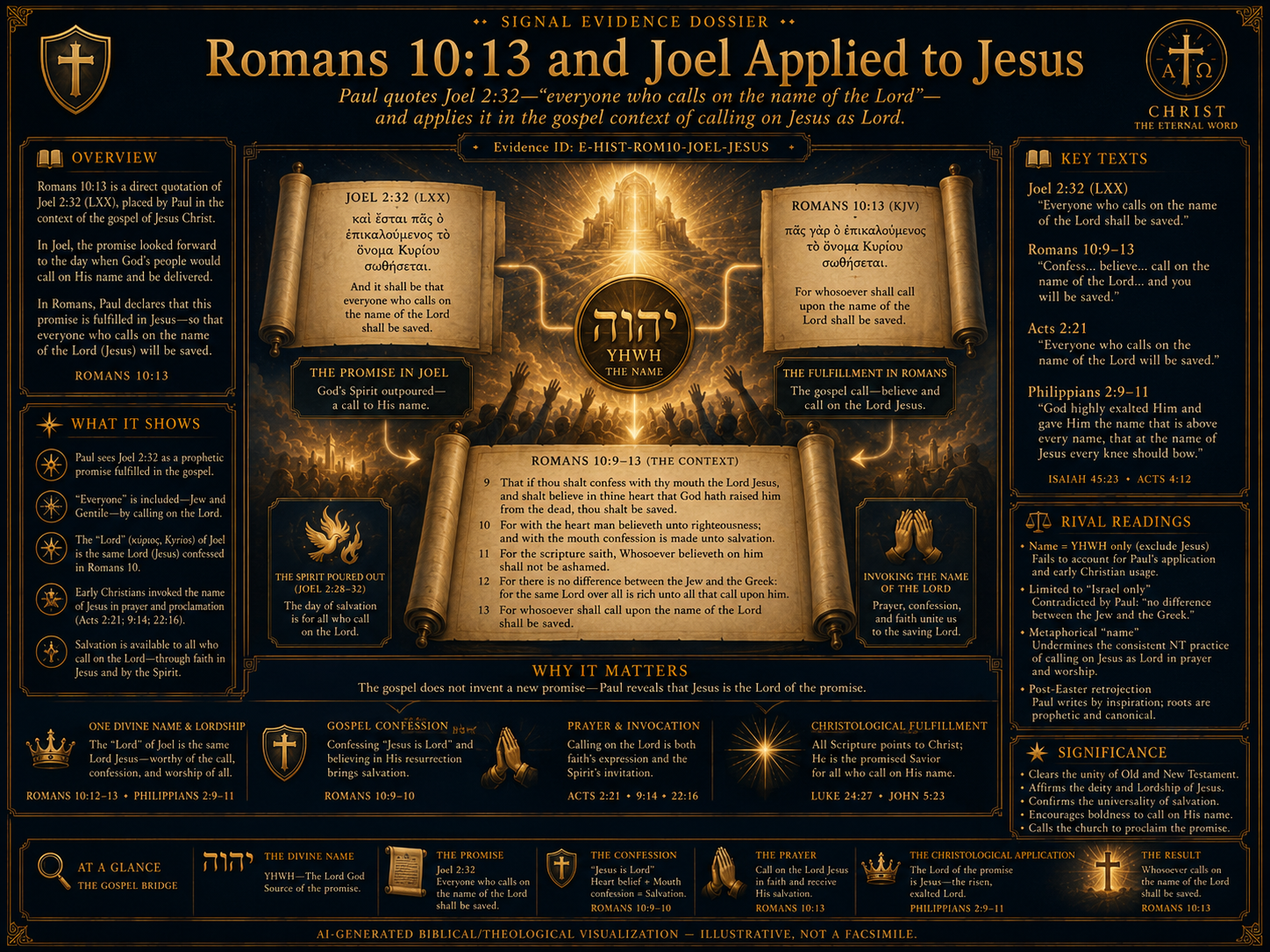
Primary Datum
Datum: Romans 10:9-13 places confession of Jesus as Lord beside Joel's promise that everyone who calls on the name of the LORD/YHWH will be saved.
Dependency / Cap Metadata
- dependency_cluster_id
- yhwh_texts_applied_to_jesus
- dependency_cluster_role
- primary_anchor
- dependency_cluster
- early_high_christology_worship
- dependency_role
- child
- cap_profile
- moderate_semi_independent
- evidence_function
- direct_identity
- directness
- direct
Counter-Pressure
- title
- Romans 10 is strong intertextual pressure, not a one-verse shortcut.
- text
- The strongest objection says Paul may be using Lord language honorifically, typologically, or through Jewish agency categories rather than directly identifying Jesus with YHWH. That pressure is real. The Christian answer is to keep the Joel/YHWH background visible while refusing to treat every Lord occurrence as automatic proof of divine identity.
- path
- Grant the ambiguity first. Then ask why an early Pauline salvation text can coordinate confession of Jesus as Lord, calling on the Lord, and Joel's YHWH-invocation promise. Keep the row with the wider cluster: Shema reworking, Maranatha, prayer/invocation, Philippians 2, Hebrews 1, and Resurrection proclamation.
Apologetic Note
- label
- Apologetic leverage
- title
- Romans 10 asks why YHWH-invocation language gathers around Jesus.
- key point
- Romans 10 does not merely say that God exists. It places Jesus-confession and salvation language beside Joel's call-on-the-name-of-the-LORD text, making the pressure specifically about Jesus and Israel's Scripture.
- conversation move
- Do not overstate the verse. Grant that Lord can be honorific, that agency readings are possible, and that Paul may be using Scripture typologically. Then ask whether prophet-only or late-development accounts can preserve the whole pattern when Romans 10 is read beside 1 Corinthians 8:6, Philippians 2, Maranatha, prayer/invocation, baptismal practice, and Resurrection proclamation.
- caveat
- This row does not prove the Trinity or full Logos Christology by itself. It is a modest, capped YHWH-text application datum inside the cumulative Christ Identity cluster.
Scripture Passage
prophecy: label: Source Text; reference: Joel 2:32; fulfillment: label: Apostolic application to Jesus; reference: Romans 10:9-13; 1 Corinthians 1:2
Caveats / Notes
- Source note
- Primary texts are Rom 10:9-13 and Joel 2:32 / LXX Joel 3:5, with 1 Cor 1:2 as related invocation context rather than duplicate scoring. Rowe and Estes remain the technical source spine for the divine-name/invocation reading; Hays is useful for Pauline intertextual method. Future source review should add precise critical counterpressure on Lord-language ambiguity, agency, typology, and exaltation readings rather than inventing unsupported citations.
- Cap notes
- Romans 10 is a central YHWH-text application row, but it overlaps with Shema reworking, Maranatha/invocation, Pauline high Christology, prayer/invocation rows, and other Scripture-application rows. Preserve row visibility while capping combined positive force.
- Cap profile note
- Semi-independent convergence rows are capped, but not treated as exact duplicates.
- Cluster note
- Capped dependent/contextual support inside the YHWH-texts-applied-to-Jesus / early high-Christology / Pauline worship-practice cluster; do not stack freely with E-HIST-1COR8-SHEMA-REWORKING, E-HIST-PHIL2-HYMN, E-HIST-MARANATHA-INVOCATION, E-HIST-PRAYER-INVOCATION-JESUS, E-HIST-EARLY-BAPTISM-NAME, E-SCR-HEB1-SON-MEDIATION, or other divine-name/Scripture-application rows. No resurrection BF applied.
- Scoring note
- v0.4 enrichment left active BF values unchanged. Capped YHWH-text application support; no Resurrection BF applied. Any future BF movement should happen only through row-level or cluster-level review.
- BF review note
- BF values were not changed in this enrichment. Later review should happen at the YHWH-texts-applied-to-Jesus cluster level after sibling dependency metadata is applied.
Machine-Readable Source
This page is generated from the public evidence mirror without recalculating or changing scores.