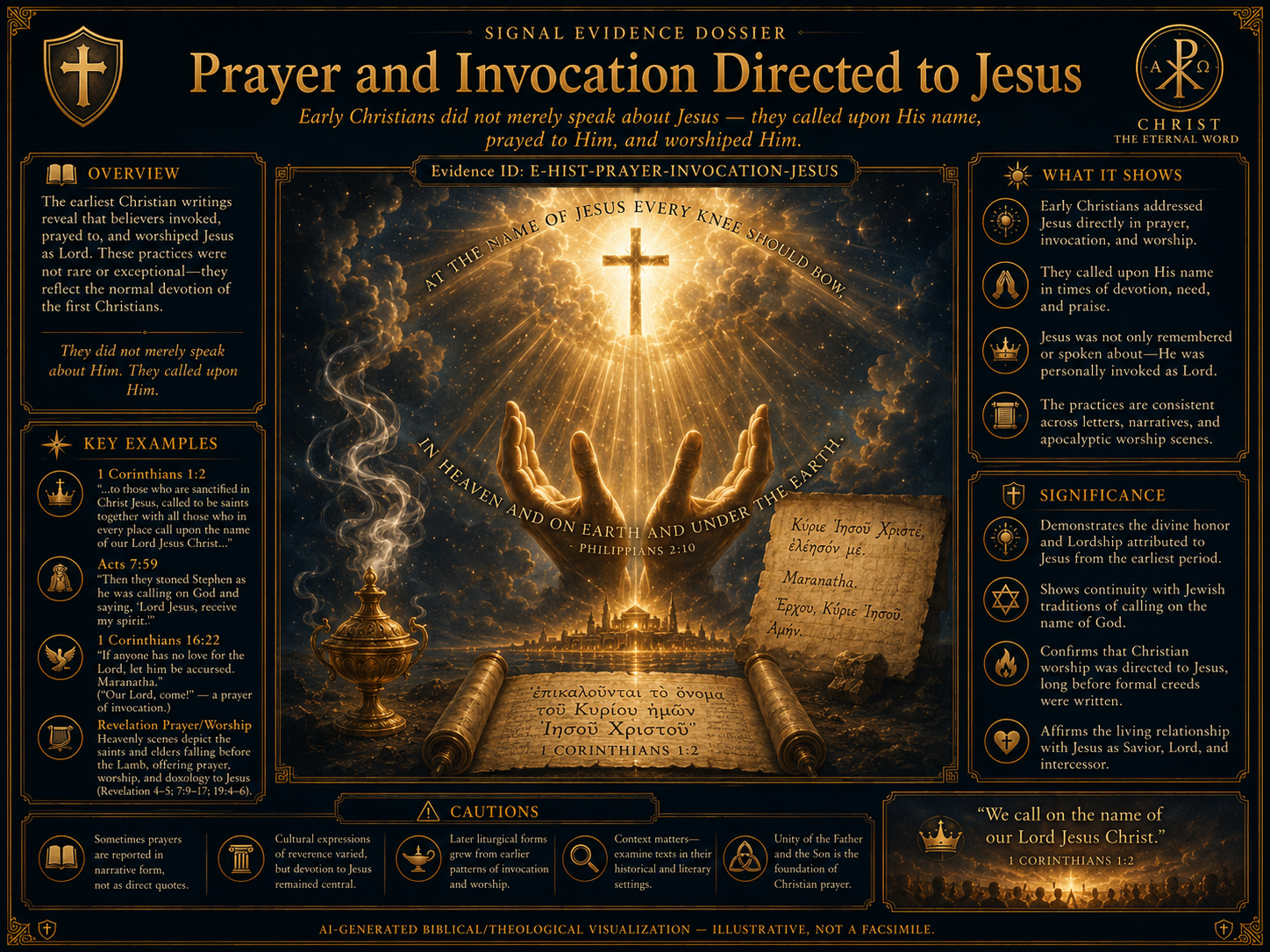
Primary Datum
Datum: Early Christian texts show Jesus receiving prayer-like address, invocation, confession, and liturgical devotion inside communities still shaped by Jewish monotheism.
Dependency / Cap Metadata
- dependency_cluster_id
- early_devotional_practice
- dependency_cluster_role
- sibling_support
- dependency_cluster
- early_high_christology_worship
- dependency_role
- child
- cap_profile
- moderate_semi_independent
- evidence_function
- direct_identity
- directness
- supporting
Counter-Pressure
- title
- Prayer and invocation language must be handled with careful categories.
- text
- The strongest objection says this is veneration of an exalted agent, liturgical convention, or post-Easter devotion rather than direct evidence of divine identity. That pressure is real. The Christian answer is not to flatten every devotional act into Nicene worship, but to ask why Jesus receives this kind of religious address so early inside Jewish monotheism.
- path
- Grant that agency, veneration, and exaltation readings explain part of the evidence. Then keep the question focused: does the whole pattern of calling on Jesus, addressing him as Lord, confessing him, and invoking him fit a merely prophet-only or late-development account once the surrounding early high Christology rows are included?
Apologetic Note
- label
- Apologetic leverage
- title
- Prayer and invocation ask why Jesus became the object of early religious address.
- key point
- The evidence is not that every phrase proves Nicene worship. The pressure is that earliest Christian communities called upon, addressed, and confessed Jesus as Lord within a Jewish monotheistic setting where divine honor was not cheap language.
- conversation move
- Begin by defining the categories: prayer, invocation, confession, veneration, worship, and liturgical address. Grant the strongest agency and exaltation readings, then ask whether they can explain why Jesus became so central to communal devotion so early when the cluster is read with Maranatha, Romans 10:13, 1 Corinthians 8:6, Philippians 2, baptismal practice, and Resurrection proclamation.
- caveat
- This row does not prove the Trinity, settle preexistence, or replace the wider Christ Identity cluster. It is a modest, capped piece of early devotional-practice evidence.
Scripture Passage
1 Corinthians 1:2; Acts 7:59-60; 2 Corinthians 12:8-9; 1 Thessalonians 3:11-13
Caveats / Notes
- Source note
- Primary texts for review include 1 Cor 1:2, Acts 7:59-60, 2 Cor 12:8-9, 1 Thess 3:11-13, Rev 22:20, and related context in Rom 10:9-13 and 1 Cor 16:22. Hurtado and Bauckham remain the positive source spine. Future source review should add precise critical counterpressure from agency, exaltation, and worship/veneration-category debates rather than inventing unsupported citations.
- Cap notes
- Prayer and invocation evidence is partly distinct because it concerns religious address and community practice, but it overlaps with Maranatha, YHWH-text application, Pauline high Christology, baptismal-name practice, and worship/invocation rows. Preserve row visibility while capping combined positive force.
- Cap profile note
- Semi-independent convergence rows are capped, but not treated as exact duplicates.
- Cluster note
- Capped dependent/contextual support inside the early devotional practice / early high-Christology / YHWH-text / Pauline worship-practice cluster; do not stack freely with E-HIST-MARANATHA-INVOCATION, E-HIST-ROM10-JOEL-JESUS, E-HIST-1COR8-SHEMA-REWORKING, E-HIST-EARLY-BAPTISM-NAME, E-HIST-PHIL2-HYMN, or other worship/invocation rows. No resurrection BF applied.
- Scoring note
- v0.4 enrichment left active BF values unchanged. Capped early devotional-practice support; no Resurrection BF applied. Any future BF movement should happen only through row-level or cluster-level review.
- BF review note
- BF values were not changed in this enrichment. Later review should happen at the early devotional practice cluster level after sibling dependency metadata is applied.
Machine-Readable Source
This page is generated from the public evidence mirror without recalculating or changing scores.