Evidence item · v0.74
Enemy attestation and early criticism (Celsus, etc.)
E-HIST-ENEMY-ATT-CRIT
Evidence item · v0.74
E-HIST-ENEMY-ATT-CRIT
Visual overview: Enemy Testimony And Early Christian History visual overview
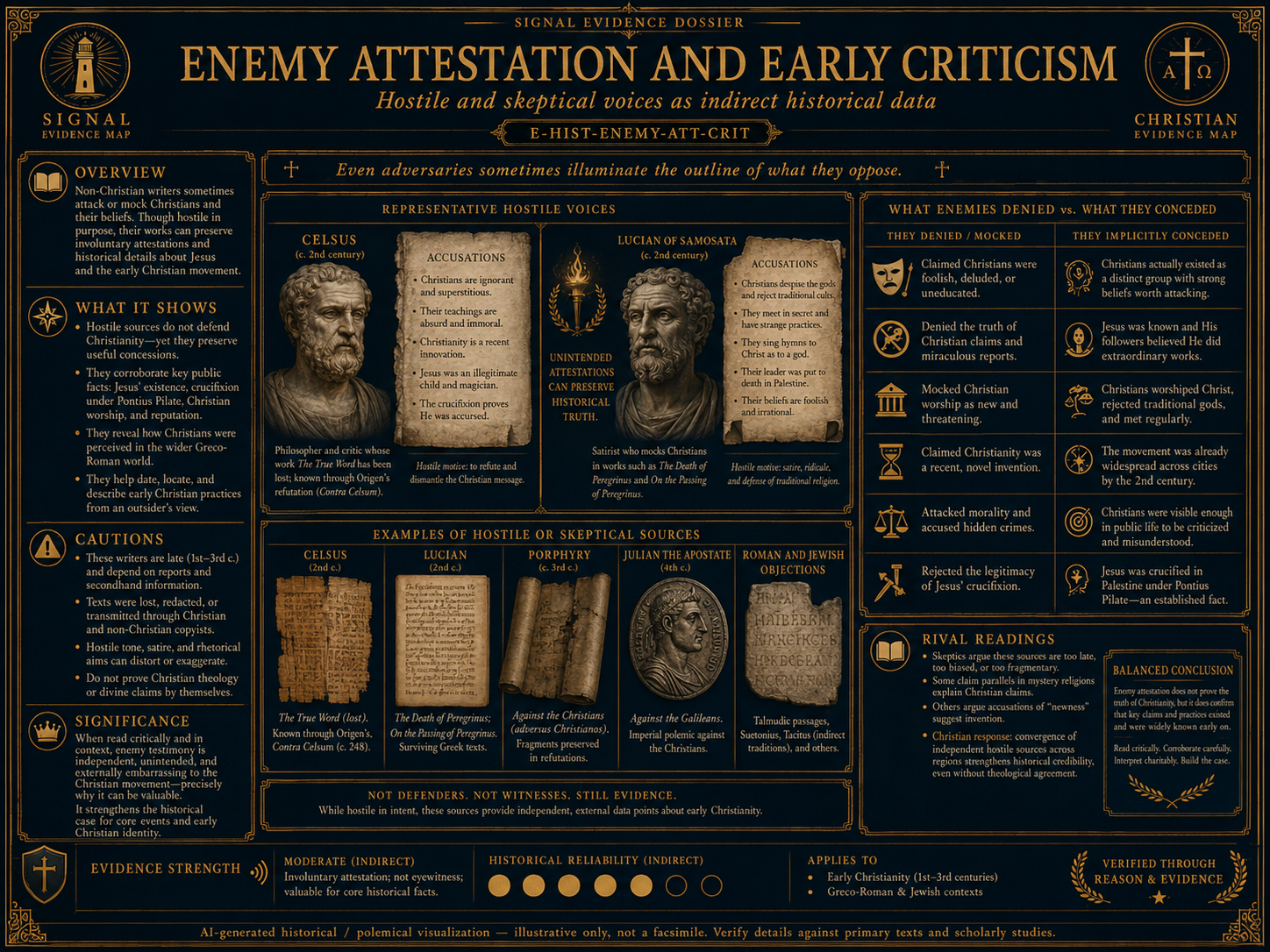
Datum: Early critics argue fraud, magic, or mistake — but rarely deny Jesus existed or was crucified.
| Hypothesis | log10BF | Min | Max | Rationale |
|---|---|---|---|---|
H-ALT-CONSPIRACY | 0 | -0.15 | 0.15 | Enemy attestation and early criticism (Celsus, etc.) leaves the conspiracy alternative possible but not especially favored. It stays neutral because basic historical anchoring does not decide which alternative best explains the later claims. |
H-ALT-HALLUCINATION | 0 | -0.15 | 0.15 | Enemy attestation and early criticism (Celsus, etc.) leaves the hallucination alternative possible but not especially favored. It stays neutral because basic historical anchoring does not decide which alternative best explains the later claims. |
H-ALT-LEGEND | -0.05 | -0.2 | 0.09999999999999999 | Enemy attestation and early criticism (Celsus, etc.) slightly pressures the legend alternative because it anchors early Christian claims in public historical memory rather than a much later invention. The effect is limited because it does not by itself prove resurrection. |
H-ALT-SWOON | 0 | -0.15 | 0.15 | Enemy attestation and early criticism (Celsus, etc.) leaves the swoon alternative possible but not especially favored. It stays neutral because basic historical anchoring does not decide which alternative best explains the later claims. |
H-DEISM | 0 | -0.15 | 0.15 | Enemy attestation and early criticism (Celsus, etc.) supplies historical background but does not clearly select Deism. It stays neutral because the row supports setting more than conclusion, and it proves neither side. |
H-GOD | 0 | -0.15 | 0.15 | Enemy attestation and early criticism (Celsus, etc.) supplies historical background but does not clearly select God. It stays neutral because the row supports setting more than conclusion, and it proves neither side. |
H-GOD-OT | 0 | -0.15 | 0.15 | Enemy attestation and early criticism (Celsus, etc.) supplies historical background but does not clearly select God-OT / classical theism. It stays neutral because the row supports setting more than conclusion, and it proves neither side. |
H-IDEALISM | 0 | -0.15 | 0.15 | Enemy attestation and early criticism (Celsus, etc.) supplies historical background but does not clearly select Idealism. It stays neutral because the row supports setting more than conclusion, and it proves neither side. |
The Signal Evidence Dataset, "Enemy attestation and early criticism (Celsus, etc.)," Evidence ID: E-HIST-ENEMY-ATT-CRIT, Version 0.74. Accessed [access date]. https://logos-signal.org/evidence/E-HIST-ENEMY-ATT-CRIT/
This page is generated from the public evidence mirror without recalculating or changing scores.