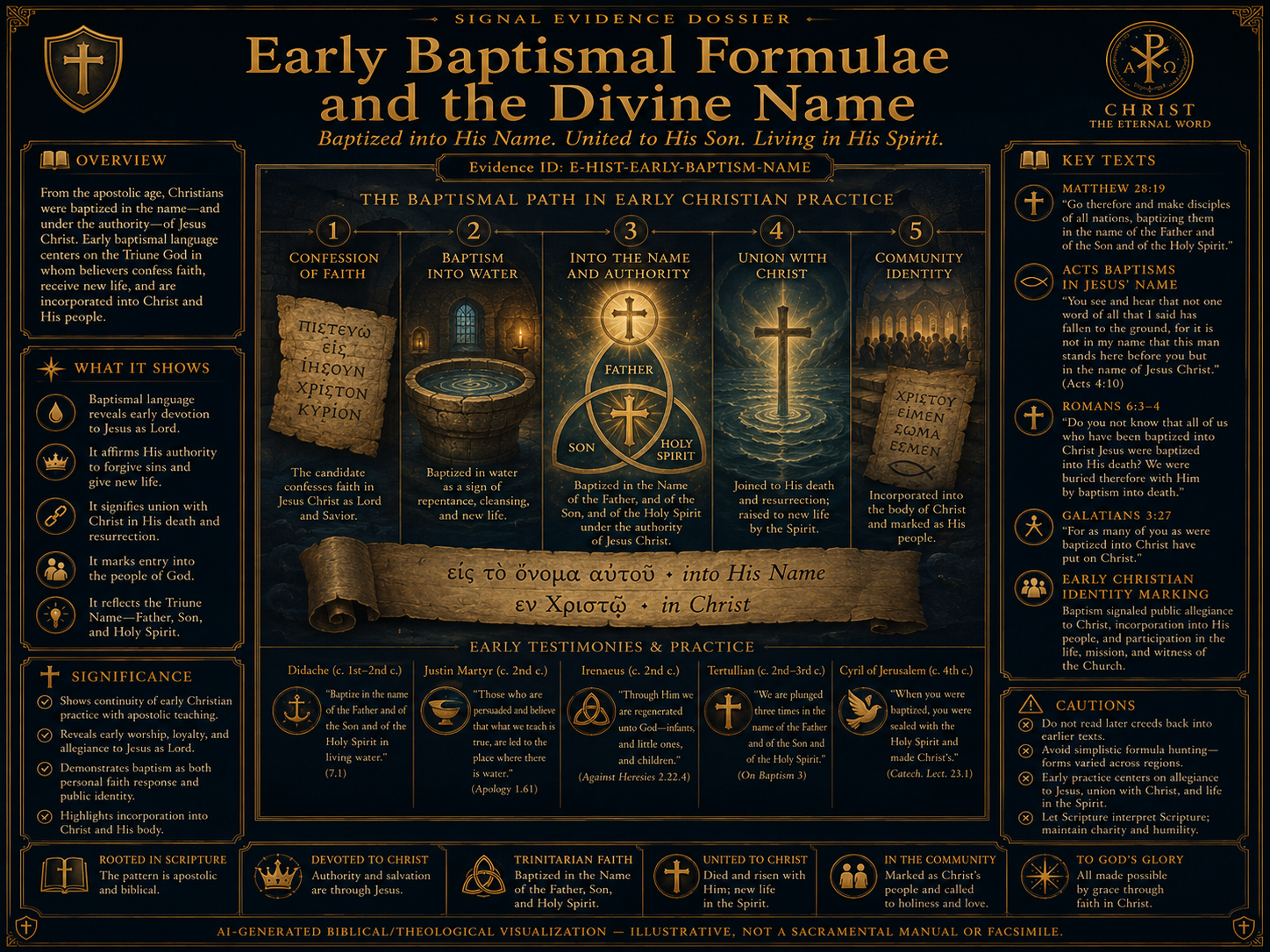
Primary Datum
Datum: Early baptismal and name-practice evidence shows Jesus placed at the center of Christian communal identity and devotion unusually early.
Dependency / Cap Metadata
- dependency_cluster_id
- early_devotional_practice
- dependency_cluster_role
- support_layer
- dependency_cluster
- early_high_christology_worship
- dependency_role
- child
- cap_profile
- moderate_semi_independent
- evidence_function
- contextual_background
- directness
- supporting
Counter-Pressure
- title
- Baptismal name-practice is early identity pressure, not instant Nicene precision.
- text
- The strongest objection says baptism in Jesus' name may mark allegiance, communal identity, or formula development rather than direct divine identity. That pressure is real. The Christian answer is to avoid overclaiming and ask why Jesus' name became so central to belonging and devotion so early.
- path
- Grant allegiance and formula-development readings first. Then keep the whole field in view: baptismal name-practice, Maranatha, prayer/invocation, Romans 10, 1 Corinthians 8, Philippians 2, and Resurrection proclamation. The name-practice row is modest, but it belongs to a larger Christ Identity pattern.
Apologetic Note
- label
- Apologetic leverage
- title
- Baptismal name-practice asks why belonging gathered around Jesus' name.
- key point
- The row is not a shortcut to later Trinitarian formulae. Its pressure is that early Christian communal identity, confession, and devotion were already being marked by Jesus' name.
- conversation move
- Grant that baptism can mark allegiance and that formulae can develop. Then ask whether a merely prophet-only or late-development account can explain why Jesus' name became so central when this row is read beside Maranatha, prayer/invocation, Romans 10, 1 Corinthians 8, Philippians 2, and Resurrection proclamation.
- caveat
- This row does not prove the Trinity or settle all baptismal-formula questions. It is a modest, capped name-practice datum inside the early devotional cluster.
Scripture Passage
Matthew 28:18-20; Acts 2:38; Acts 8:16; Acts 10:48; Acts 19:5; Didache 7; 1 Corinthians 1:13-17
Caveats / Notes
- Source note
- Expanded to include Matthew 28:18-20 and precise baptism/name-practice source controls. DATA-approved early-Christology / tradition Batch values remain unchanged; capped dependent support; no Resurrection BF applied.
- Cap notes
- Baptismal-name and prayer-practice evidence is useful, but it overlaps with Maranatha, prayer/invocation, Romans 10, Shema reworking, YHWH-text application, Pauline high Christology, and other early devotional-practice rows. Preserve row visibility while capping combined positive force.
- Cap profile note
- Semi-independent convergence rows are capped, but not treated as exact duplicates.
- Cluster note
- Capped dependent/contextual support inside the early devotional practice / creed / worship-practice cluster; do not stack freely with E-HIST-MARANATHA-INVOCATION, E-HIST-PRAYER-INVOCATION-JESUS, E-HIST-ROM10-JOEL-JESUS, E-HIST-1COR8-SHEMA-REWORKING, E-HIST-PHIL2-HYMN, or other Logos/hymn/tradition items. No Resurrection BF applied.
- Scoring note
- DATA-approved early-Christology / tradition Batch values; v0.4 enrichment left active BF values unchanged; capped dependent support; no Resurrection BF applied.
- Governance note
- Visible scored support within existing capped early high-Christology/worship structure. Matthew 28 material was added here rather than as a new row to avoid duplicating the baptism/name-practice cluster.
- BF review note
- BF values were not changed in this enrichment. Later review should happen at the early devotional practice cluster level after sibling rows are fully enriched.
Machine-Readable Source
This page is generated from the public evidence mirror without recalculating or changing scores.