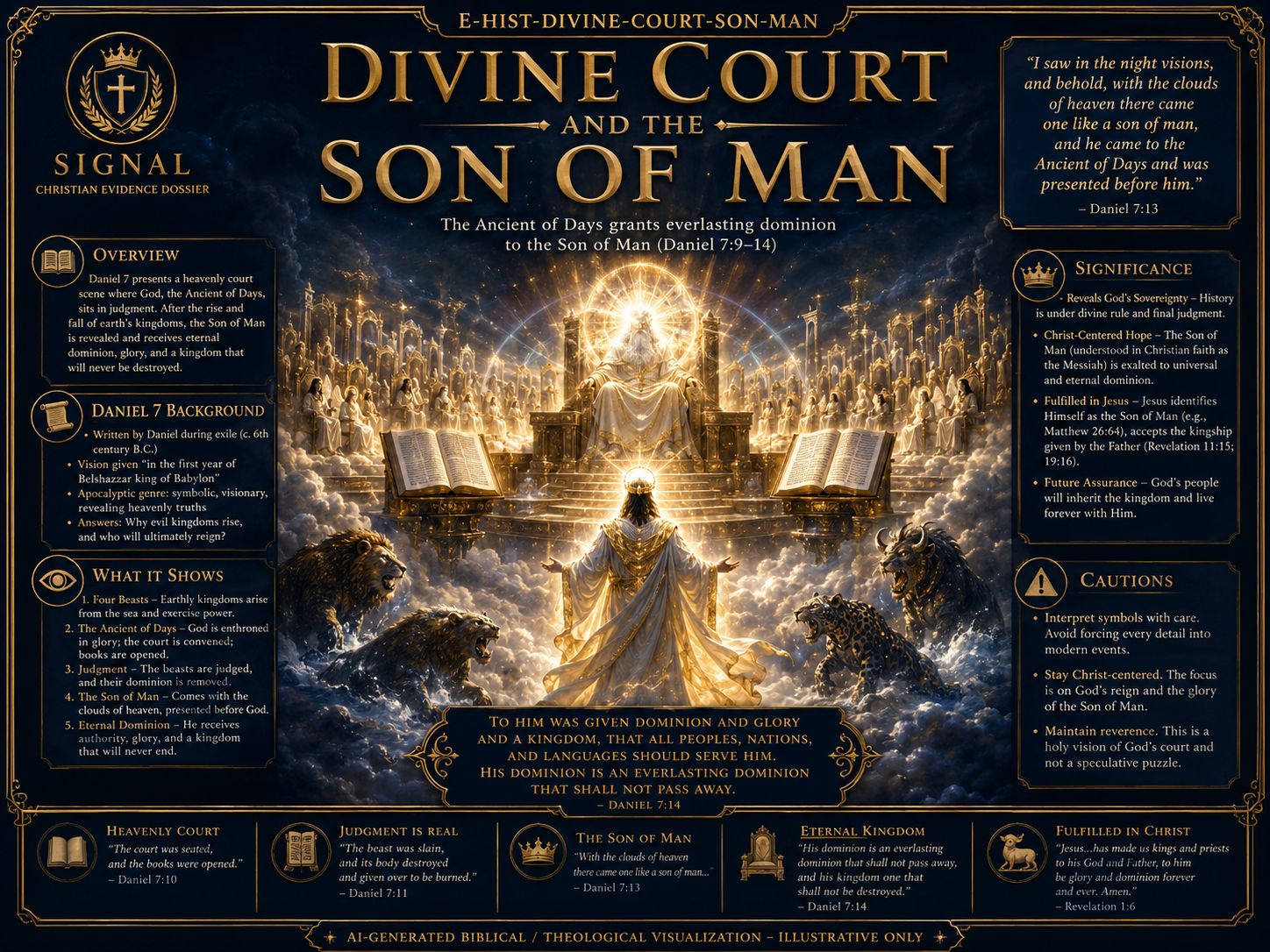
Primary Datum
Datum: Danielic and divine-court background strengthens the interpretive pressure behind Synoptic Son of Man language.
Dependency / Cap Metadata
- dependency_cluster_id
- son_of_man_divine_court
- dependency_cluster_role
- primary_anchor
- dependency_cluster
- synoptic_divine_prerogatives
- dependency_role
- context_child
- cap_profile
- moderate_semi_independent
- evidence_function
- direct_identity
- directness
- supporting
Counter-Pressure
- title
- Son of Man language is debated, and Daniel 7 can be read more than one way.
- text
- The strongest objection says this row may turn a flexible phrase into a title, read Daniel 7 too individualistically, or mistake apocalyptic agency for ontological divine identity. That pressure is real. The Christian answer is not to flatten the debate, but to ask why the Synoptic portrait keeps drawing Jesus into the courtroom and throne-room grammar of final authority.
- path
- Start with the cautious reading: idiom, corporate Daniel 7, and agency categories are possible. Then widen the lens to judgment authority, the trial scene, temple authority, sins-forgiven authority, Philippians 2, Romans 10, Hebrews 1, and early worship. The cumulative question is why this much divine-court weight gathers around Jesus.
Apologetic Note
- label
- Apologetic leverage
- title
- Danielic Son of Man language asks why Jesus is placed in the divine court.
- key point
- This is not generic theism. The row places Jesus' Son of Man language in a divine-court world of vindication, dominion, judgment, and enthronement. That creates Christ-specific pressure against merely-prophet or merely-teacher reductions.
- conversation move
- Do not claim Daniel 7 alone proves the Trinity. Grant idiom, corporate, agency, and royal readings, then ask whether those readings can carry the whole pattern when this row is read with Son of Man judgment, the trial scene, temple authority, Resurrection proclamation, and early devotion to Jesus.
- caveat
- The row is background and context pressure, not standalone Nicene proof. It belongs to a cumulative, dependency-capped Son of Man / divine-court cluster.
Scripture Passage
prophecy: label: Scripture background; reference: Daniel 7:13-14; Psalm 110:1; fulfillment: label: Jesus' use before the council; reference: Mark 14:62
Caveats / Notes
- Source note
- This row is background pressure from Danielic/divine-court context for Synoptic Son of Man language and must not duplicate the Son of Man judgment anchor. Existing citations provide the current source spine; future review may add precise Allison, Dunn, Ehrman, or additional Second Temple apocalyptic citations rather than inventing unsupported publication details.
- Cap notes
- Danielic divine-court background is partly distinct as context for the Son of Man lane, but it overlaps with Son of Man judgment authority, trial/blasphemy material, Daniel 7, Psalm 110, temple authority, and broader Synoptic divine-prerogative rows. Preserve row visibility while capping shared-source force.
- Cap profile note
- Semi-independent convergence rows are capped, but not treated as exact duplicates.
- Cluster note
- Danielic and divine-court background is a Christ Identity support lane. Do not stack freely with E-HIST-SON-MAN-JUDGMENT, E-HIST-TRIAL-BLASPHEMY-TEMPLE, Daniel 7 material, Psalm 110 material, or Synoptic divine-prerogative rows.
- Scoring note
- v0.4 enrichment left active BF values unchanged. Scored in the Synoptic divine-prerogatives lane as dependency-capped support; no Resurrection BF applied. Any future BF movement should happen only through row-level or cluster-level review.
- BF review note
- BF values were not changed in this enrichment. Later review should happen at the Son of Man / divine-court cluster level after sibling rows are enriched.
Machine-Readable Source
This page is generated from the public evidence mirror without recalculating or changing scores.