Primary Datum
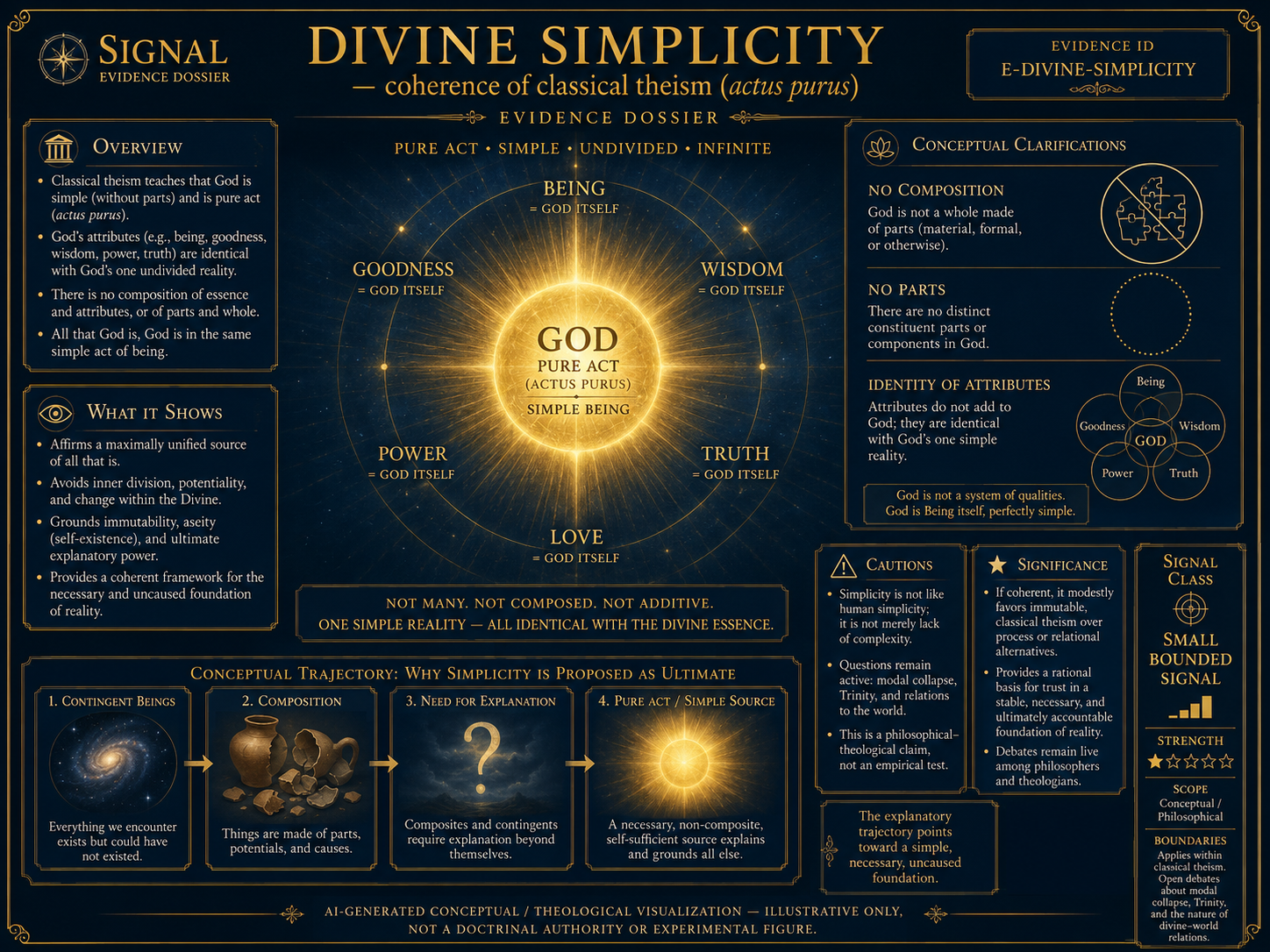
Datum: divine simplicity claims God is not made of parts and is identical with his attributes.
Dependency / Cap Metadata
- dependency_cluster_id
- theology_proper_attributes
- dependency_cluster_role
- sibling_support
- dependency_cluster
- theology_proper_attributes
- dependency_role
- sibling_support
- cap_profile
- moderate_semi_independent
- evidence_function
- context_child
- directness
- supporting
Counter-Pressure
- title
- Divine Simplicity — coherence of classical theism (actus purus) is a bounded signal, not a standalone proof.
- text
- The strongest caution is overuse. Attribute coherence is not direct evidence for Christianity by itself. This row should be read inside its dependency family, not treated as an isolated demonstration of God, Christ, or the final synthesis.
- path
- Start with what the row actually shows, then name what it does not show. Use it to clarify what kind of God the staged argument is pointing toward.
Apologetic Note
- label
- Bounded positive signal
- title
- Divine simplicity gives classical theism real contours.
- key point
- Classical theism claims God is without parts and identical with His attributes (simple; pure act). The leverage is not bare assertion that God exists, but the internal fit of attributes such as mind, love, necessity, relation, simplicity, and moral seriousness.
- conversation move
- Use the item after theism is already on the table. Ask whether the God being proposed can preserve personality, transcendence, goodness, worship, and covenant without contradiction.
- caveat
- Treat this as a bounded positive signal: it gives real help to the Christian map while leaving live pressure for the wider case. Do not treat attribute coherence as proof by itself. It clarifies the candidate explanation so the wider evidence can test it fairly.
Scripture Passage
reference: Deuteronomy 6:4; label: The Lord is one, reference: James 1:17; label: No shifting shadow
Caveats / Notes
- Cap notes
- This row belongs to the theology-proper support family. It should be read as support-layer evidence rather than direct proof of the full Logos synthesis by itself.
- Cap profile note
- Semi-independent convergence rows are capped, but not treated as exact duplicates.
- Cluster note
- Divine-attributes cap: this row addresses theology proper and should not be used as direct Christology, resurrection, or revealed-religion evidence.
Machine-Readable Source
This page is generated from the public evidence mirror without recalculating or changing scores.