Primary Datum
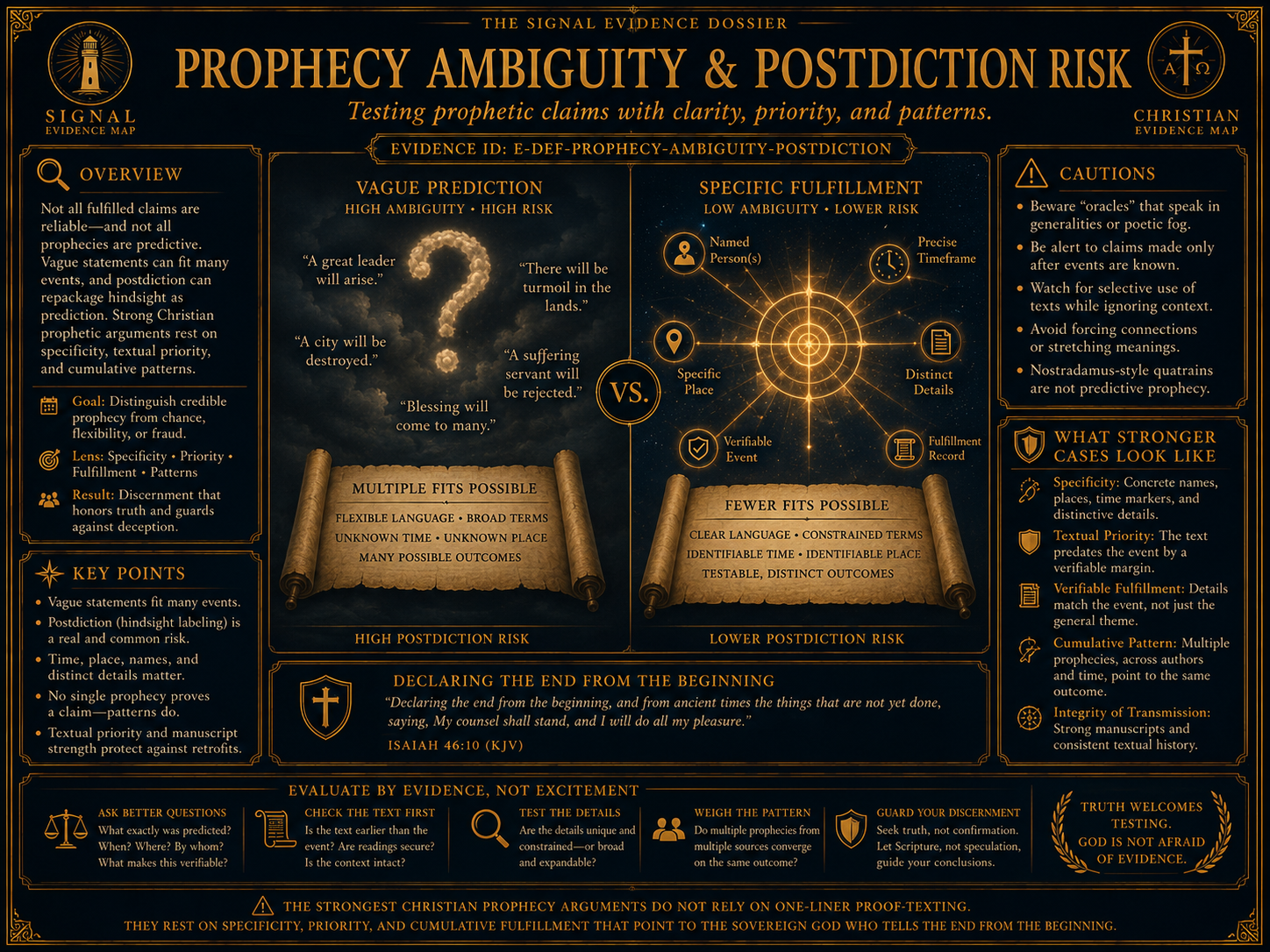
Datum: prophecy can be ambiguous, typological, or retrospectively applied, creating pressure against overconfident fulfillment claims.
Dependency / Cap Metadata
- dependency_cluster_id
- textual_canon_objections
- dependency_cluster_role
- defeater
- dependency_cluster
- scripture_throughline_typology
- dependency_role
- anchor
- cap_profile
- rival_pressure
- evidence_function
- defeater
- directness
- methodological
Counter-Pressure
- title
- Prophecy is strongest as converging pattern, not fortune-telling theater.
- text
- Ambiguity and postdiction risk are real. Christians should not grab a verse, ignore its first context, and declare victory. But that does not make the prophetic pattern empty. The deeper question is why king, servant, temple, exile, sacrifice, new covenant, nations, and kingdom converge so stubbornly around Christ.
- path
- Read the original setting first, then the canonical trajectory. Ask whether the Christian reading is a forced trick or a cumulative pattern that makes better sense after Christ. The strongest apologetic is not one isolated prediction, but a web of promises, types, offices, wounds, and hopes that find their center in Jesus without erasing Israel.
Apologetic Note
- label
- Rival-pressure use
- title
- Prophecy is not a magic trick; it is a pattern that comes into focus in Christ.
- key point
- A skeptic can fairly ask whether Christians are reading Jesus back into old texts. The answer should not be cheap proof-texting. The stronger point is convergence: king, servant, sacrifice, temple, exile, covenant, nations, and kingdom all begin to make sense around Christ.
- conversation move
- Tell the student: read the Old Testament text in its own setting first. Then ask why the whole story keeps bending toward Jesus. One verse may be debated; the pattern is harder to shrug off.
- caveat
- Do not pretend every prophecy is obvious or that Jewish readings are foolish. The Christian claim is that Christ fulfills the story, not that context does not matter.
Scripture Passage
label: Representative servant text under dispute; reference: Isaiah 53:3-7, label: Representative chronology text under dispute; reference: Daniel 9:24-27, label: Representative birthplace text under dispute; reference: Micah 5:2
Caveats / Notes
- Source note
- Require side-by-side Jewish, Christian, and historical-critical readings of key texts (Isaiah, Daniel, Micah, Psalms, Zechariah). Distinguish prediction, typology, and retrospective fitting claims before any later scoring attempt.
- Cap notes
- This row preserves genuine defeater pressure. Future cap diagnostics may govern overlap with sibling objections, but should not hide the objection or treat it as answered by default.
- Cap profile note
- Rival and defeater pressure is capped within its own family and kept visible.
- Scoring note
- Scored in textual_canon_scripture_defeater_scoring_pass; marked as canonical:E-DEF-PROPHECY-AMBIGUITY-POSTDICTION for later scripture-throughline/typology governance; single-row group means no shrinkage unless related rows are later assigned to this anchor.
Machine-Readable Source
This page is generated from the public evidence mirror without recalculating or changing scores.