Primary Datum
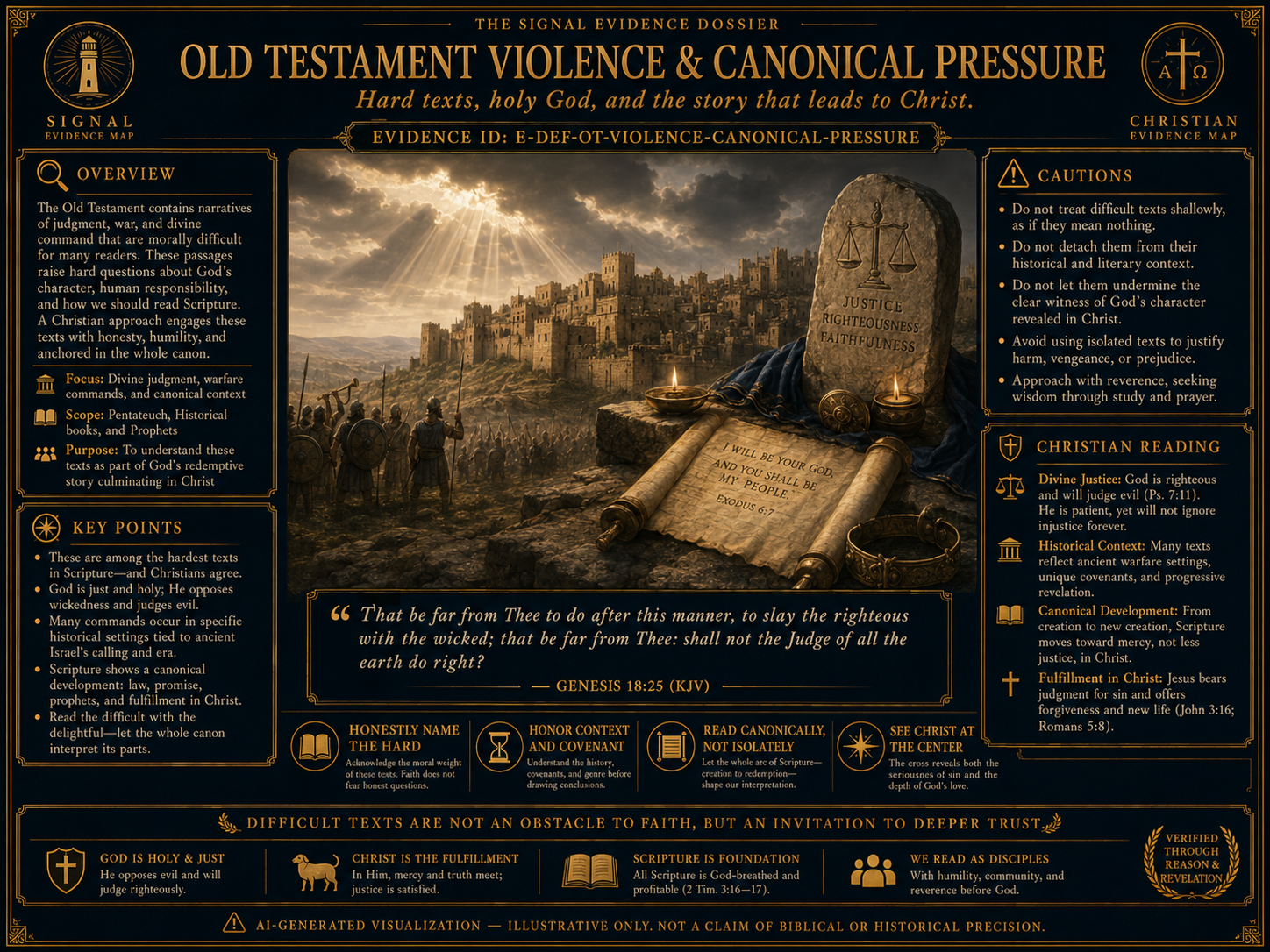
Datum: severe Old Testament violence texts create moral pressure within the canon and Christian interpretation.
Dependency / Cap Metadata
- dependency_cluster_id
- textual_canon_objections
- dependency_cluster_role
- defeater
- dependency_cluster
- evil_hiddenness_pluralism
- dependency_role
- child
- cap_profile
- rival_pressure
- evidence_function
- defeater
- directness
- contextual
Counter-Pressure
- title
- The hard texts are a moral burden, not a shortcut to atheism.
- text
- Do not begin by making the hard text small. Begin by making the moral question large. If cruelty is truly evil, not merely disliked by our century, then the objector is appealing to a real moral law. That is not a neutral platform outside the Christian argument. It is already a confession that persons matter, justice is real, and evil is not chemistry wearing a frown.
That does not make Joshua easy. It means the shortcut fails. Removing God does not remove the horror of evil; it removes the objective ground on which evil can be named as horror. The protest has force only if there is a moral reality high enough to judge ancient kings, modern readers, Israel, Canaan, and us.
Then open the canon. The Bible itself does not read these texts as simple tribal extermination. Deuteronomy speaks of the nations being driven out little by little. Joshua later assumes remaining peoples. Judges records Canaanites still living in the land. Ancient war language often speaks in total victory terms, and the canon gives the reader controls against a flat modern casualty-report reading.
Finally, read toward Christ without pretending the pressure disappears. Scripture presents bounded judgment, not ethnic hatred; moral seriousness, not bloodlust; and a kingdom that is not advanced by the sword. The final self-disclosure of God is the crucified and risen Christ, who bears judgment, commands enemy-love, and forbids His people to turn Scripture into a license for cruelty.
- path
- First, concede the weight. Say plainly that these texts are hard and that Christians should not answer them with slogans.
Second, press the moral foundation. Ask what worldview makes the outrage objective. If the complaint is that the violence is really evil, not merely personally offensive, then the objector has invoked a moral law that needs a ground.
Third, read the texts with the whole Bible open. Bring in Deuteronomy 7:22, Joshua 23:12-13, and Judges 1:27-28. The canon itself shows gradual dispossession and remaining peoples, so the simplistic reading that every conquest phrase means literal extermination of every individual is already under pressure from Scripture.
Fourth, refuse misuse. Do not frame this against the Jewish people, do not sanitize the texts, and do not let ancient context become a magic eraser. The answer is patient reading, not evasive reading.
Fifth, take the question to Christ. Christians are not commanded to imitate conquest warfare. Christ fulfills the story, bears judgment in Himself, commands love of enemies, and declares that His kingdom is not advanced by the sword.
Apologetic Note
- label
- Rival-pressure use
- title
- The hard Old Testament texts should make Christians careful, not silent.
- key point
- This objection matters because violence is morally serious. Christians should not shrug at that. But the objection also assumes real moral truth: cruelty is actually wrong. Christianity can ground that moral protest, then read the texts through ancient context, Israel's own judgment, and Christ.
- conversation move
- Say: I agree these texts are hard. Then ask two questions. First, what worldview makes moral outrage more than personal preference? Second, what does the whole Bible do with violence, judgment, mercy, enemy-love, and the Cross?
- caveat
- Do not sanitize the texts or make God sound tribal. Read honestly, historically, and canonically, with Christ as the final revelation of God.
Scripture Passage
reference: Deuteronomy 7:22; label: Gradual dispossession, not instant erasure, reference: Joshua 23:12-13; label: Joshua assumes remaining nations, reference: Judges 1:27-28; label: Judges records Canaanites remaining, reference: Matthew 5:43-45; label: Christ forbids enemy-hatred as Christian posture, reference: John 18:36; label: Christ's kingdom is not advanced by the sword
Caveats / Notes
- Source note
- Require genre and ancient Near Eastern rhetoric controls, including Copan/Flannagan's hyperbole argument and the connected reading of Deuteronomy, Joshua, and Judges. Keep critical pressure visible from Niditch/Seibert. Preserve the Lennox-style moral-grounding question and exclude anti-Jewish misuse.
- Cap notes
- This row preserves genuine defeater pressure. Future cap diagnostics may govern overlap with sibling objections, but should not hide the objection or treat it as answered by default.
- Cap profile note
- Rival and defeater pressure is capped within its own family and kept visible.
- Scoring note
- Scored in global_defeater_scoring_pass_1; dependency-capped under canonical:E-DEF-EVIL-HORRENDOUS-SUFFERING; no Resurrection BF applied.
Machine-Readable Source
This page is generated from the public evidence mirror without recalculating or changing scores.