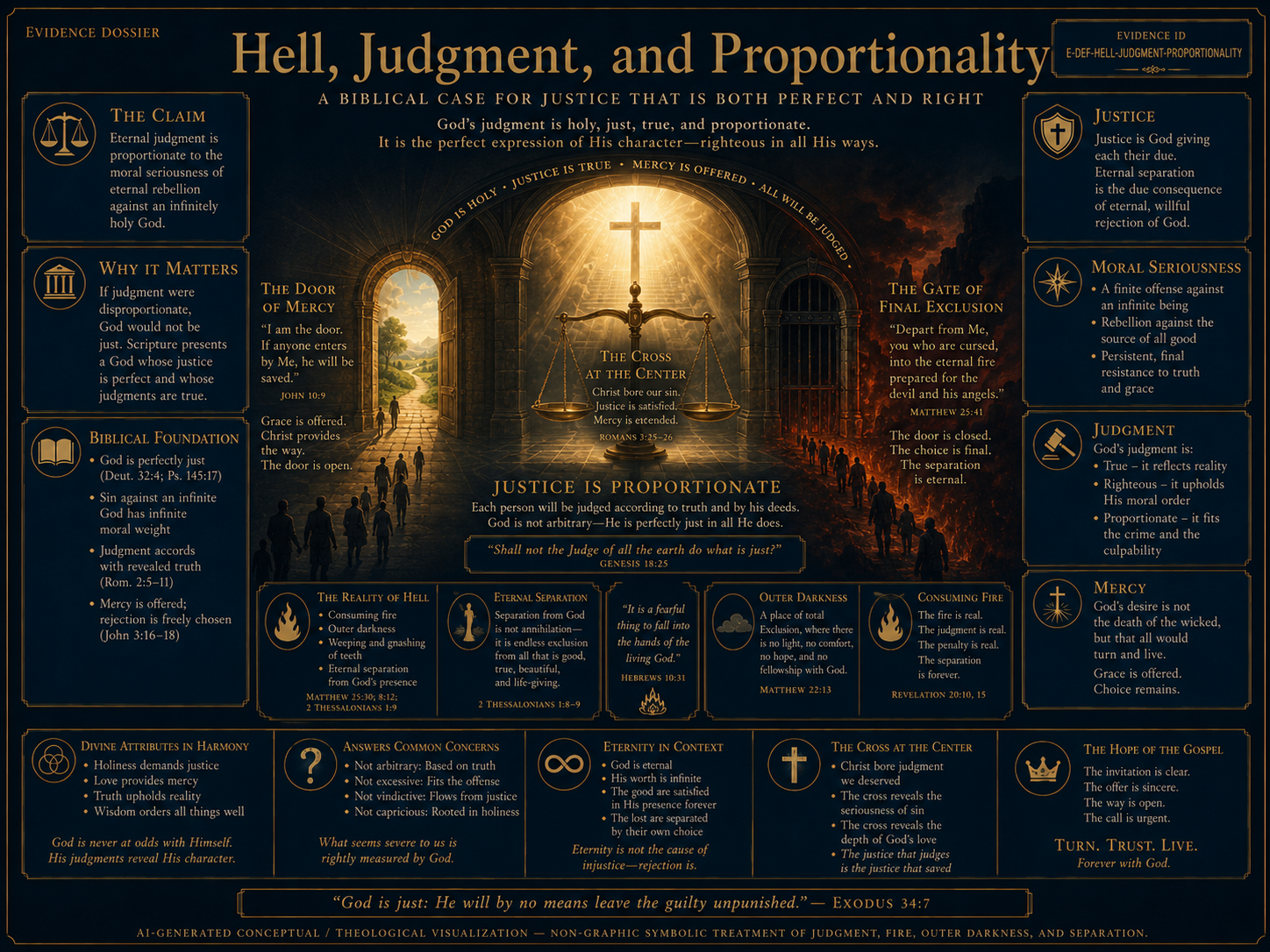
Primary Datum
Datum: hell and judgment doctrines pressure questions of divine goodness, justice, and proportionality.
Dependency / Cap Metadata
- dependency_cluster_id
- evil_hiddenness_pluralism
- dependency_cluster_role
- defeater
- dependency_cluster
- evil_hiddenness_pluralism
- dependency_role
- child
- cap_profile
- rival_pressure
- evidence_function
- defeater
- directness
- direct
Counter-Pressure
- title
- The scandal of hell must be faced, but evil also must be judged.
- text
- The pressure here is real: proportionality, finality, and the unevangelized cannot be handled with slogans. But removing judgment does not automatically solve the moral problem. It can create a new one: a world where evil finally gets no answer. Christianity says judgment is not God losing His love, but holy love refusing to call evil harmless. The cross keeps this from becoming cheap severity, because the Judge enters the dock and bears judgment before judging the world.
- path
- Grant the moral weight. Then ask what a good God should do with evil that victims cannot repair and history cannot undo. Name the live Christian debates honestly: eternal conscious punishment, annihilationism, and universalist hope are not the same account. But keep the shared center clear: God is just, human persons are morally serious, evil is not waved away, and Christ's mercy is not indifference to wrong.
Apologetic Note
- label
- Rival-pressure use
- title
- Judgment is frightening, but a world without judgment is not obviously more moral.
- key point
- Hell and judgment raise real proportionality questions. But the Christian answer begins with the seriousness of evil: if murder, abuse, cruelty, betrayal, and oppression are real moral facts, then final accountability is not automatically barbaric. A universe with no final reckoning is not obviously kinder to victims.
- conversation move
- Move the conversation from caricature to moral reality. Ask whether love can be real while evil is finally shrugged away. Then say clearly that Christians debate models of hell, duration, finality, annihilation, and universal hope, but all serious Christian accounts insist that God is just, no one is treated as disposable, and Christ bears judgment before He announces it.
- caveat
- Do not make hell sound like divine sadism. Do not erase judgment as if evil were harmless. Keep the cross at the center: Christian judgment theology must be spoken from the place where God Himself bears sin's cost.
Scripture Passage
Matthew 25:46; Revelation 20:11-15; 2 Thessalonians 1:8-10
Caveats / Notes
- Source note
- Frame pressure through proportionality, duration, freedom, and justice debates. Include ECT/annihilation/universalist models with primary representatives (Walls, Fudge, Hart) and classical background (Augustine/Aquinas).
- Cap notes
- This row preserves genuine defeater pressure. Future cap diagnostics may govern overlap with sibling objections, but should not hide the objection or treat it as answered by default.
- Cap profile note
- Rival and defeater pressure is capped within its own family and kept visible.
- Scoring note
- Scored in global_defeater_scoring_pass_1; dependency-capped under canonical:E-DEF-EVIL-HORRENDOUS-SUFFERING; no Resurrection BF applied.
Machine-Readable Source
This page is generated from the public evidence mirror without recalculating or changing scores.