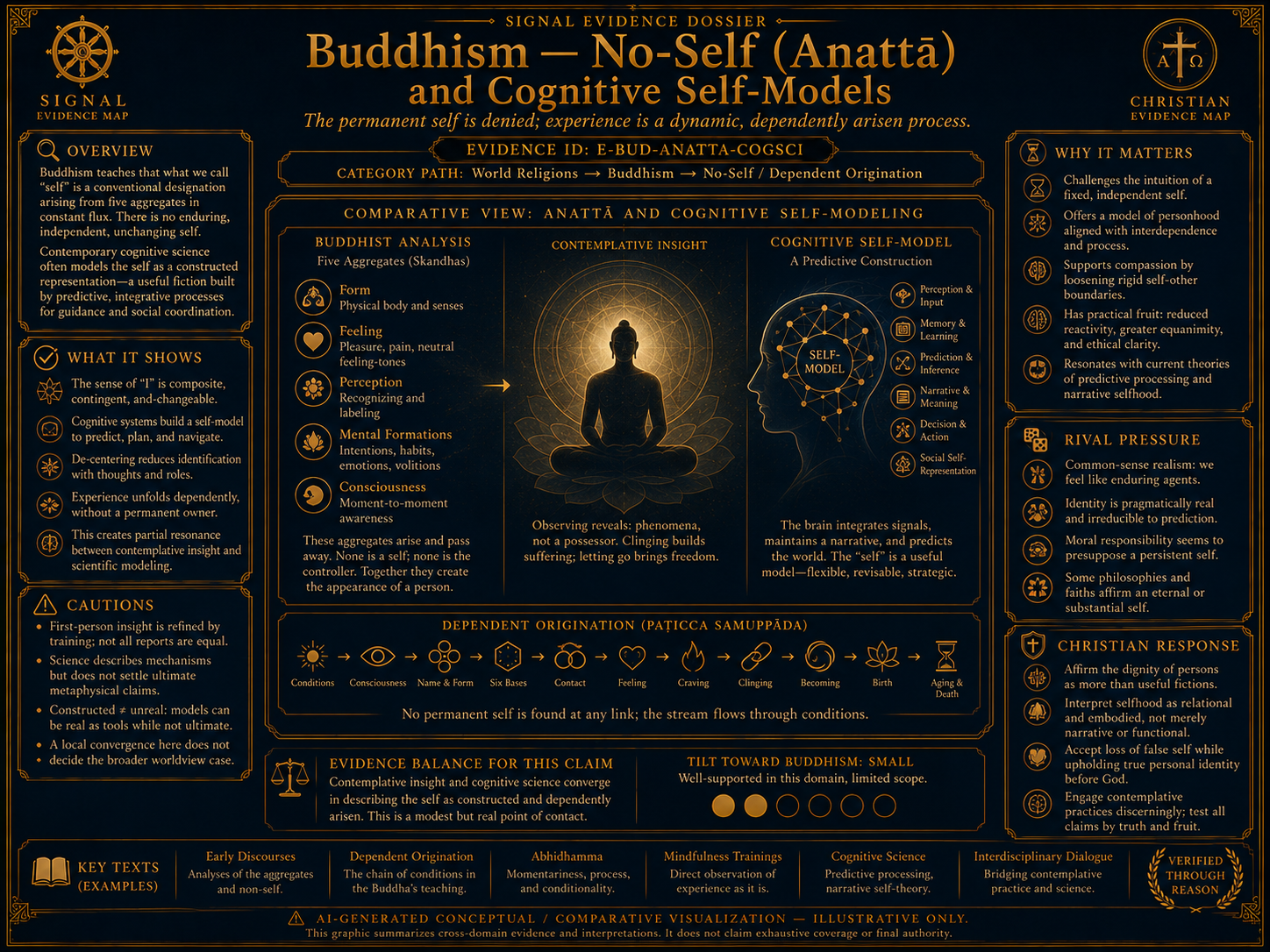
Primary Datum
Datum: Buddhist no-self teaching partially aligns with cognitive-science models of the self as constructed, predictive, and process-like.
Dependency / Cap Metadata
- dependency_cluster_id
- buddhism_rival_case
- dependency_cluster_role
- defeater
- dependency_cluster
- buddhism_rival_case
- dependency_role
- defeater
- cap_profile
- rival_pressure
- evidence_function
- defeater
- directness
- supporting
Counter-Pressure
- title
- Buddhism names suffering seriously; Christianity asks what heals the sufferer.
- text
- Buddhism — no-self (anattā) and cognitive self-models: Buddhism has real force when it talks about craving, suffering, discipline, and compassion. A Christian should not laugh that off. The question is whether the final answer is the loss of self, or the redemption of persons in communion with God.
- path
- Start with respect: Buddhism sees a real wound. Then compare cures. Is our deepest problem attachment, or sin and death? Is hope escape from personhood, or resurrection and healed love? Do not caricature Buddhism as nihilism. The Christian answer should be respectful and clear: Christ saves the person; He does not erase the person.
Apologetic Note
- label
- Comparative rival signal
- title
- Buddhism names suffering seriously; Christianity asks what heals the sufferer.
- key point
- Buddhism — no-self (anattā) and cognitive self-models: Buddhism has real force when it talks about craving, suffering, discipline, and compassion. A Christian should not laugh that off. The question is whether the final answer is the loss of self, or the redemption of persons in communion with God.
- conversation move
- Start with respect: Buddhism sees a real wound. Then compare cures. Is our deepest problem attachment, or sin and death? Is hope escape from personhood, or resurrection and healed love?
- caveat
- Do not caricature Buddhism as nihilism. The Christian answer should be respectful and clear: Christ saves the person; He does not erase the person.
Caveats / Notes
- Cap notes
- This row preserves rival-worldview pressure for fair comparison. Future cap diagnostics may govern overlap with sibling rival rows, but should not hide the challenge.
- Cap profile note
- Rival and defeater pressure is capped within its own family and kept visible.
- Cluster note
- Buddhism fair-seat cap: supports Buddhist-family coherence only within this doctrine/practice; repeated no-self/dukkha/practice rows are dependent and should not stack freely against other traditions.
Machine-Readable Source
This page is generated from the public evidence mirror without recalculating or changing scores.