Primary Datum
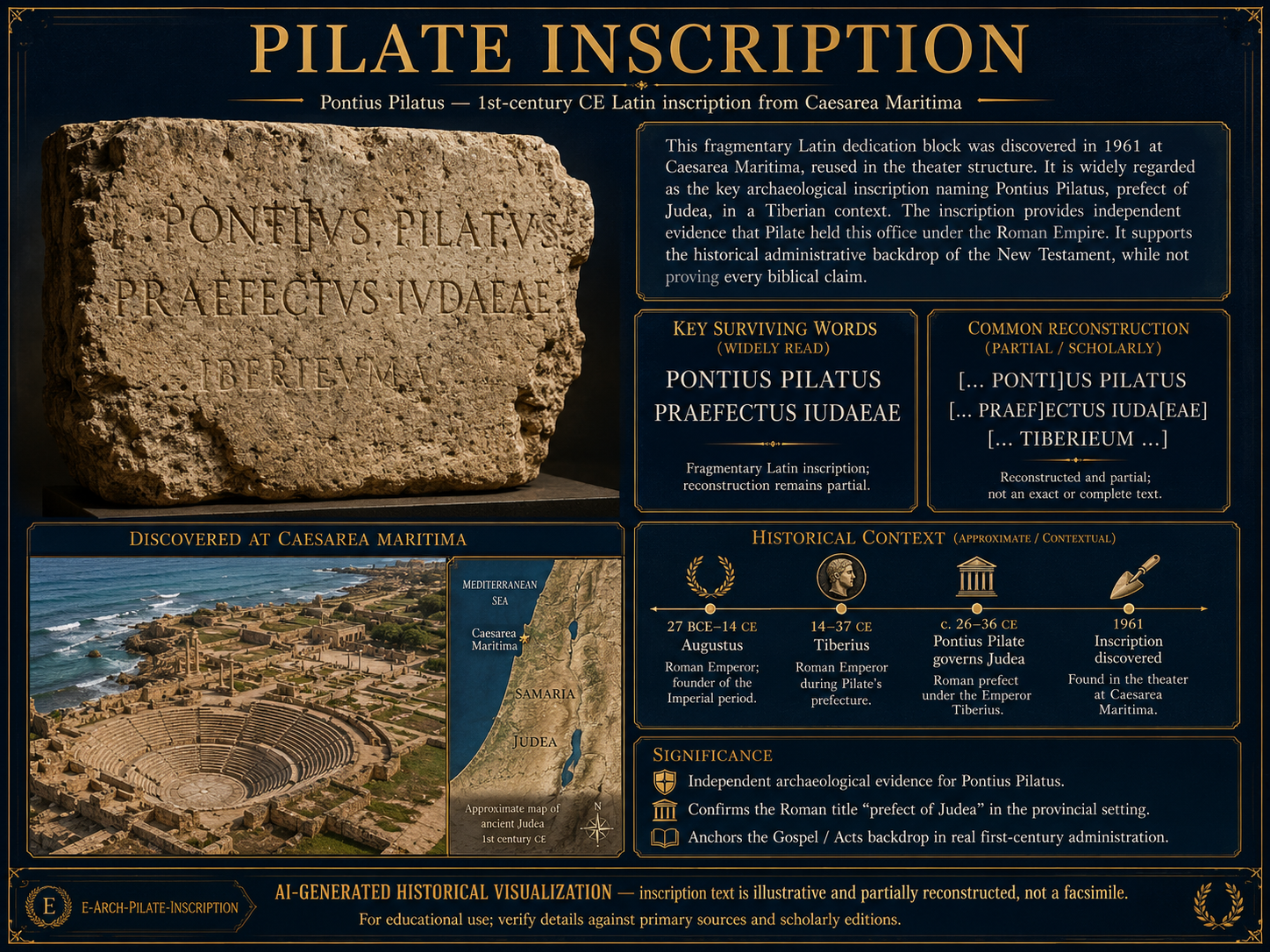
Datum: the Pilate inscription from Caesarea names Pontius Pilate as prefect of Judea.
Dependency / Cap Metadata
- dependency_cluster_id
- new_testament_historical_synchronisms
- dependency_cluster_role
- sibling_support
- dependency_cluster
- new_testament_historical_synchronisms
- dependency_role
- sibling_support
- cap_profile
- support_layer_small
- evidence_function
- support_layer
- directness
- supporting
Counter-Pressure
- title
- Pilate inscription at Caesarea (prefect of Judea) — synchronism is a bounded signal, not a standalone proof.
- text
- The strongest caution is overuse. Synchronisms are support-layer evidence. They do not, by themselves, prove miracles, Resurrection, or Christ as Logos. This row should be read inside its dependency family, not treated as an isolated demonstration of God, Christ, or the final synthesis.
- path
- Start with what the row actually shows, then name what it does not show. Use it to show that the texts are not floating myth, then keep the theological claim tied to stronger direct rows.
Apologetic Note
- label
- Apologetic leverage
- title
- Pilate inscription at Caesarea (prefect of Judea) - synchronism puts public detail on the table.
- key point
- A reused Latin dedication block from Caesarea Maritima (found 1961) names Pontius Pilatus, prefect of Judea, in a Tiberian context. The positive signal is local precision: names, offices, and civic details behave like contact with remembered history.
- conversation move
- Ask why a merely foggy legend so often lands on the hard furniture of public administration. Precision does not prove theology, but it raises confidence in the world being described.
- caveat
- Do not overstate synchronisms. They support historical embeddedness, not every claim in the Christian confession.
Caveats / Notes
- Cap notes
- Historical/material synchronism support layer; primarily supports Scripture historical embeddedness and alternative-pressure constraints.
- Cap profile note
- Support-layer rows stay small even when visible and inspectable.
- Governance note
- Moved direct H-CHRIST-IDENTITY material-culture weight to H-SCRIPTURE-HIST-EMBEDDEDNESS support.
Machine-Readable Source
This page is generated from the public evidence mirror without recalculating or changing scores.