Primary Datum
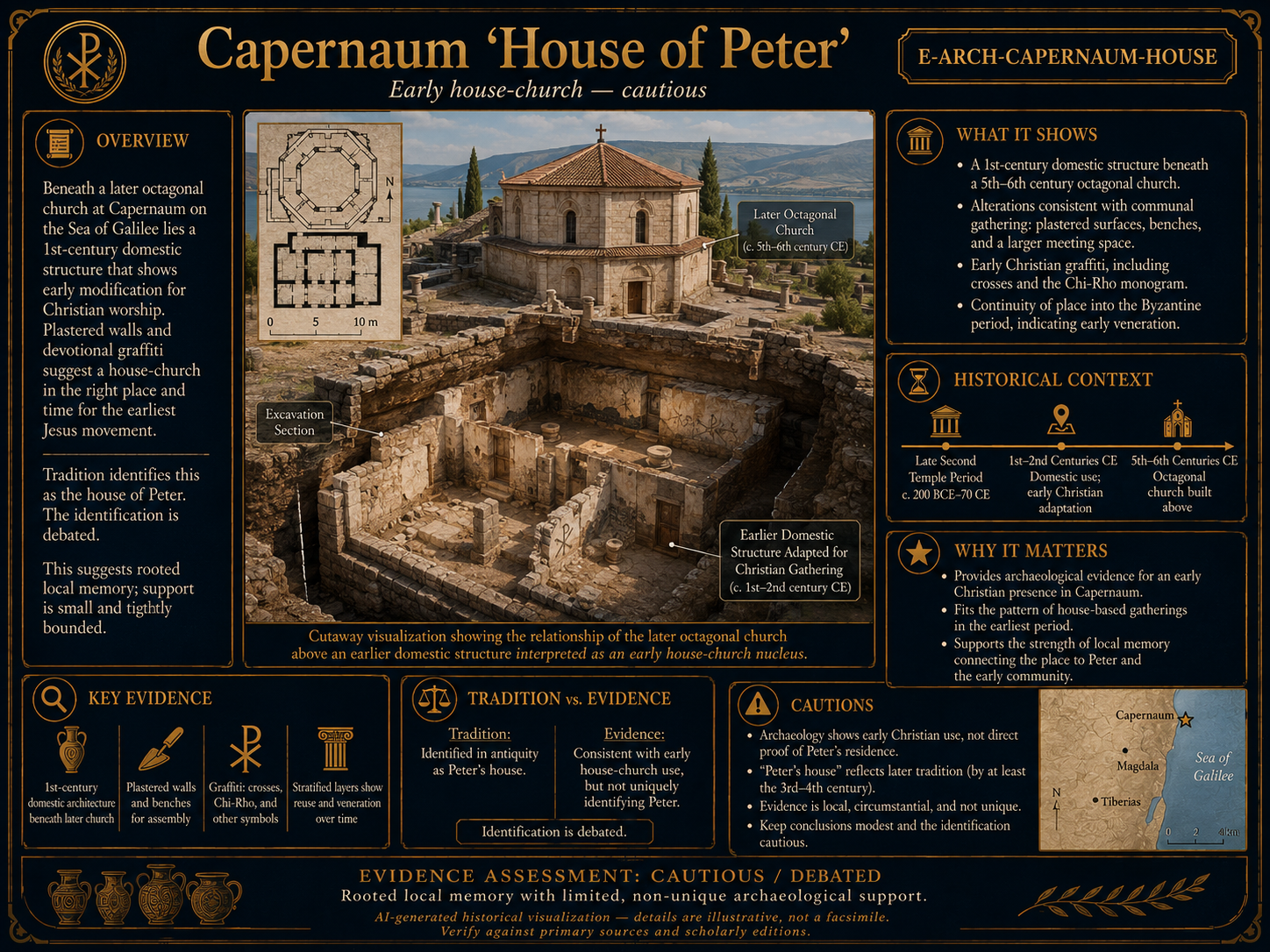
Datum: a Capernaum domestic structure appears to have been adapted early for Christian gathering and later venerated as Peter's house.
Dependency / Cap Metadata
- dependency_cluster_id
- new_testament_historical_synchronisms
- dependency_cluster_role
- sibling_support
- dependency_cluster
- new_testament_historical_synchronisms
- dependency_role
- sibling_support
- cap_profile
- support_layer_small
- evidence_function
- support_layer
- directness
- supporting
Counter-Pressure
- title
- Capernaum 'house of Peter' (early house-church) — cautious is a bounded signal, not a standalone proof.
- text
- The strongest caution is overuse. Synchronisms are support-layer evidence. They do not, by themselves, prove miracles, Resurrection, or Christ as Logos. This row should be read inside its dependency family, not treated as an isolated demonstration of God, Christ, or the final synthesis.
- path
- Start with what the row actually shows, then name what it does not show. Use it to show that the texts are not floating myth, then keep the theological claim tied to stronger direct rows.
Apologetic Note
- label
- Apologetic leverage
- title
- Capernaum 'house of Peter' (early house-church) is useful precisely because it stays cautious.
- key point
- The clue is not that Capernaum 'house of Peter' (early house-church) settles the case. It shows how an artifact or inscription can add historical texture while still requiring careful limits.
- conversation move
- Use the caution as part of the apologetic. Say what Capernaum 'house of Peter' (early house-church) plausibly supports, what it does not prove, and why the biblical world remains historically inspectable.
- caveat
- Do not lean on disputed identification as though it were a pillar. Let it be a small piece of public texture inside the wider case.
Caveats / Notes
- Cap notes
- Historical/material synchronism support layer; primarily supports Scripture historical embeddedness and alternative-pressure constraints.
- Cap profile note
- Support-layer rows stay small even when visible and inspectable.
- Governance note
- Moved direct H-CHRIST-IDENTITY material-culture weight to H-SCRIPTURE-HIST-EMBEDDEDNESS support.
Machine-Readable Source
This page is generated from the public evidence mirror without recalculating or changing scores.