Evidence item · v0.74
Religious Cognition Across Cultures
E-ANTHRO-RELIGIOUS-COGNITION-CROSS-CULTURAL
Evidence item · v0.74
E-ANTHRO-RELIGIOUS-COGNITION-CROSS-CULTURAL
Visual overview: Religious Cognition Across Cultures Map visual overview
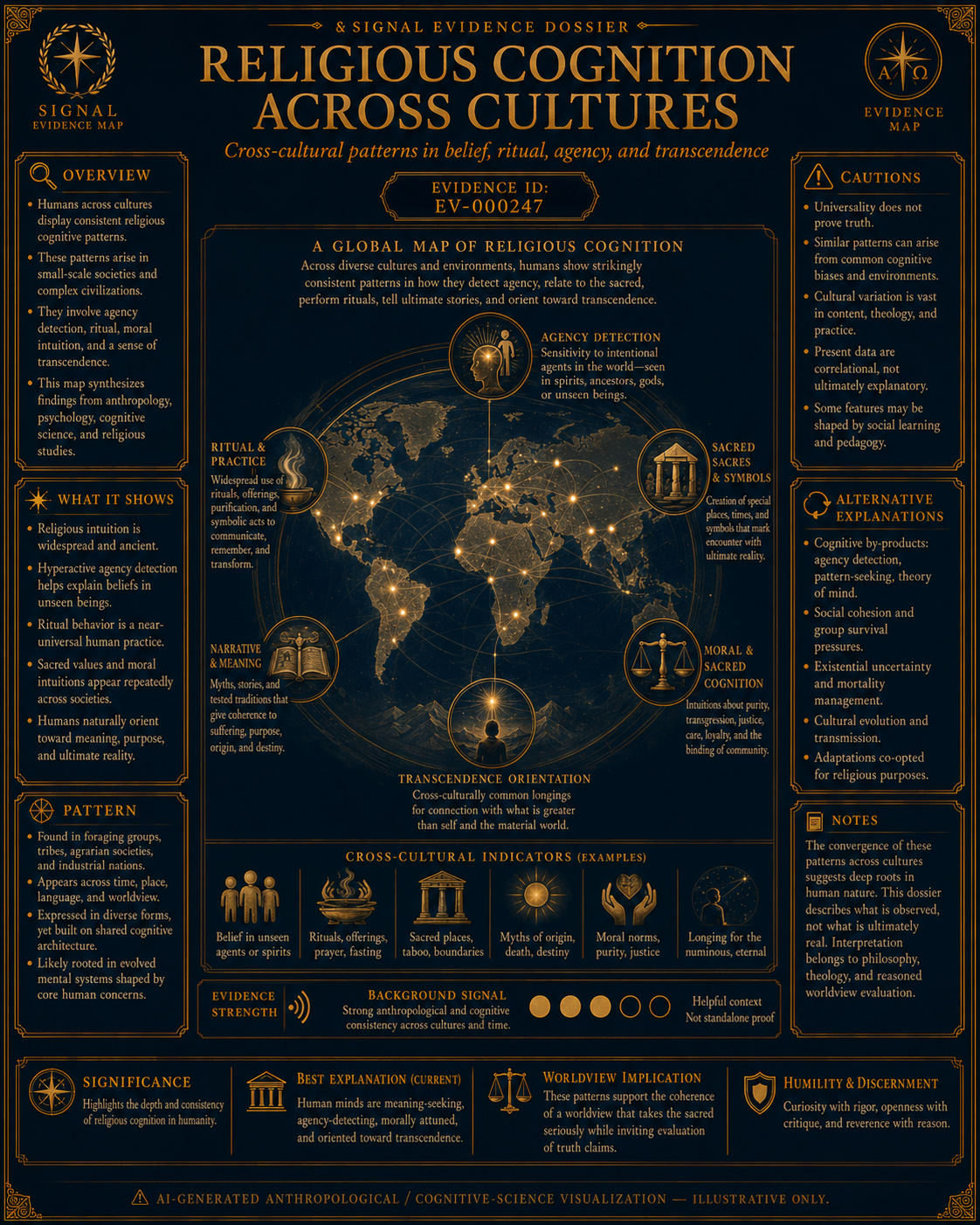
Datum: religious cognition and practice appear widely across human cultures.
| Hypothesis | log10BF | Min | Max | Rationale |
|---|---|---|---|---|
H-DEISM | 0 | -0.04 | 0.04 | Deism can allow religious cognition, but it does not strongly predict widespread relational, ritual, and supernatural practice. |
H-GOD | 0.02 | -0.03 | 0.07 | Cross-cultural religious cognition is modestly expected if humans have an orientation toward the divine, but universality alone does not identify which religion is true. |
H-IDEALISM | 0 | -0.04 | 0.04 | Mind-first metaphysics can accommodate religious experience, but cross-cultural religion is not specific enough to favor idealism. |
H-NATURALISM | 0.02 | -0.03 | 0.07 | Cognitive and social mechanisms such as agency detection, pattern recognition, and cohesion can explain why religious thought is widespread without proving it false. |
The Signal Evidence Dataset, "Religious Cognition Across Cultures," Evidence ID: E-ANTHRO-RELIGIOUS-COGNITION-CROSS-CULTURAL, Version 0.74. Accessed [access date]. https://logos-signal.org/evidence/E-ANTHRO-RELIGIOUS-COGNITION-CROSS-CULTURAL/
This page is generated from the public evidence mirror without recalculating or changing scores.