Primary Datum
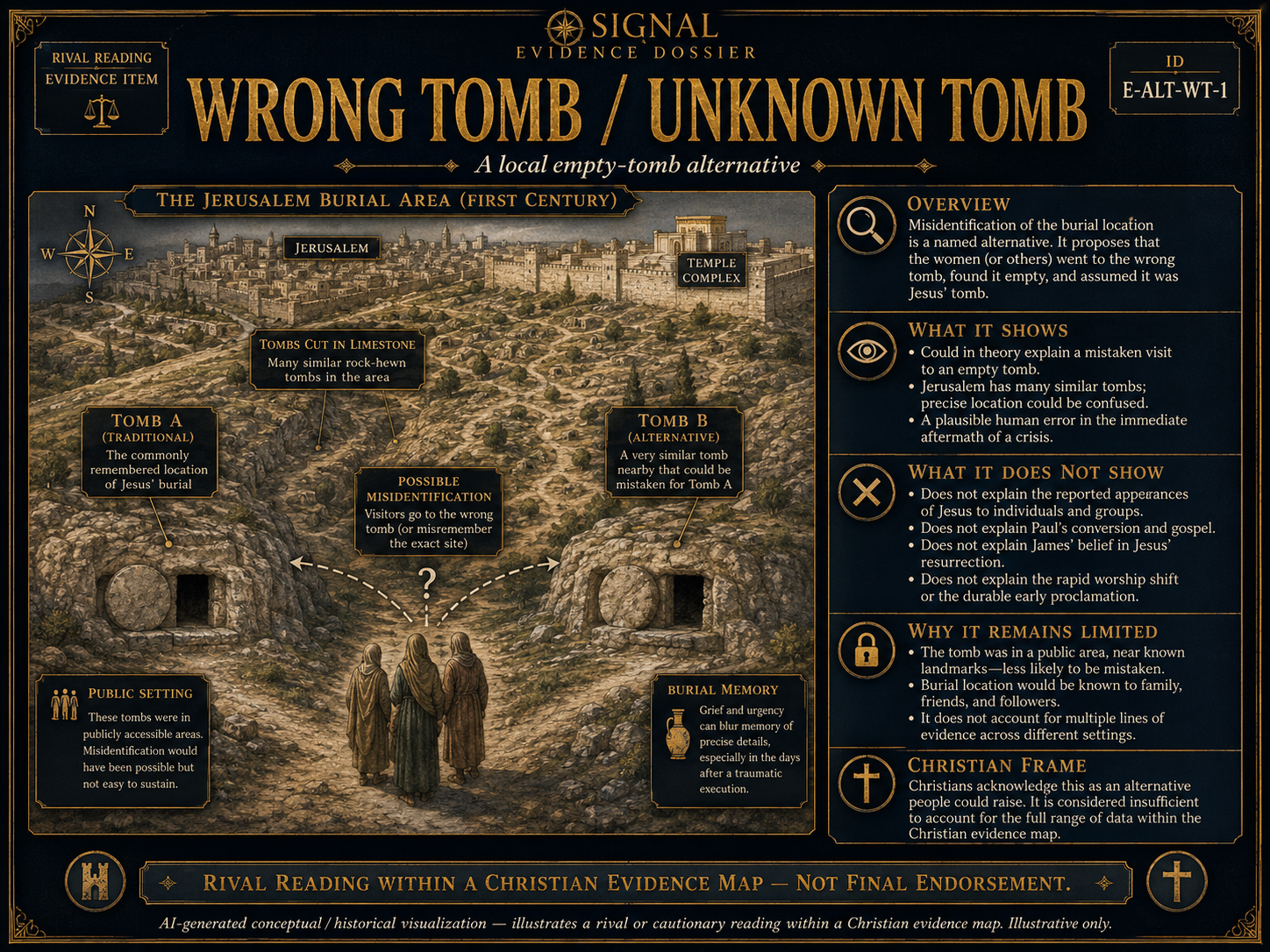
Datum: The wrong-tomb theory can locally explain an empty-tomb claim if the first visitors were mistaken or the burial location was unclear.
Dependency / Cap Metadata
- dependency_cluster_id
- resurrection_alternative_explanations
- dependency_cluster_role
- defeater
- dependency_cluster
- resurrection_alternatives
- dependency_role
- child
- cap_profile
- rival_pressure
- evidence_function
- rival_positive
- directness
- supporting
Counter-Pressure
- title
- The wrong tomb explains a mistake, but not a movement.
- text
- The wrong-tomb theory is useful because it is ordinary: people can go to the wrong place. But ordinary explanations still need fit. The model must explain why the claim became Resurrection rather than 'the tomb was misplaced,' why authorities or locals did not correct it, why appearances became central, why Paul and James were persuaded, and why the movement survived in Jerusalem, the very place where tomb-location correction would have been easiest.
- path
- Use it as a local challenge, not a total explanation. Ask: whose tomb was wrong, who knew the right one, and why did no one settle the matter? Then widen the lens. The early Christian claim was not merely 'we found an empty spot'; it was 'God raised Jesus.' A wrong-tomb account has to bridge the distance from navigational error to public resurrection proclamation.
Apologetic Note
- label
- Rival-pressure use
- title
- Wrong-tomb explanations are local and concrete.
- key point
- This row has force because mistake about location is a simple, non-conspiratorial explanation for an empty-tomb claim. It deserves a place in the map.
- conversation move
- Grant its simplicity, then ask whether it fits named burial memory, public correction possibilities, appearance claims, Paul, James, and the shift from confusion to Resurrection proclamation.
- caveat
- Do not let the wrong-tomb model explain appearances or Christology by assumption. It is primarily a tomb-location hypothesis.
Scripture Passage
label: Women at the tomb in Mark; reference: Mark 16:1-8, label: Women at the tomb in Luke; reference: Luke 24:1-12, label: Mary Magdalene at the tomb; reference: John 20:1-18
Caveats / Notes
- Source note
- Use Kirsopp Lake for the classic wrong-tomb proposal and preserve the model as a local tomb-location explanation, not a full account of appearances, Paul, James, or early worship.
- Cap notes
- This row preserves the wrong-tomb rival explanation as a local tomb-location alternative. Future cap diagnostics may govern overlap with other tomb alternatives, but should not hide the objection or treat it as answered by default.
- Cap profile note
- Rival and defeater pressure is capped within its own family and kept visible.
- Scoring note
- Scored directly to H-ALT-WRONG-TOMB; not proxied through legend or conspiracy.
Machine-Readable Source
This page is generated from the public evidence mirror without recalculating or changing scores.