Primary Datum
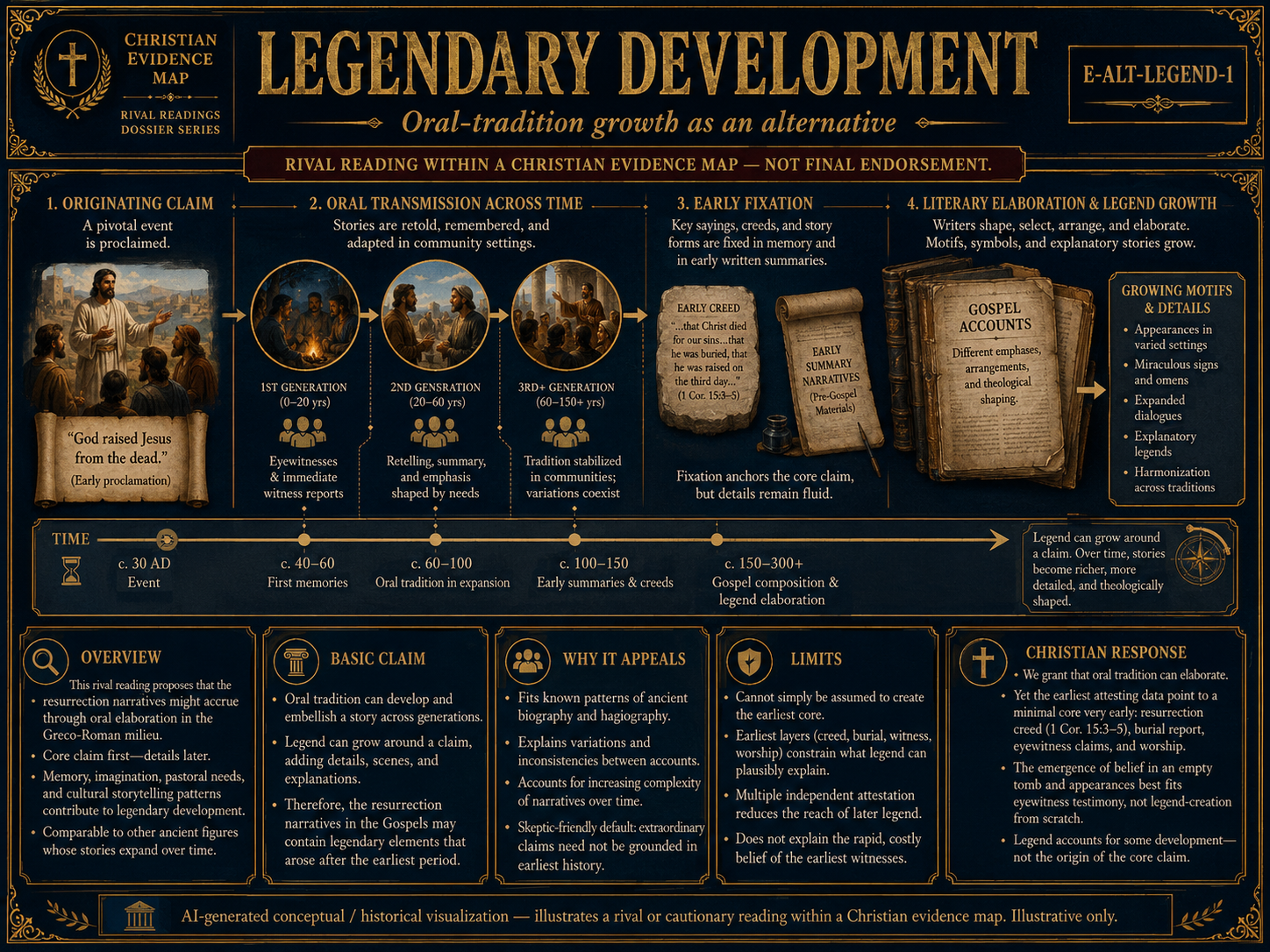
Datum: Claims that resurrection narratives accrued through oral elaboration in Greco-Roman milieu.
Dependency / Cap Metadata
- dependency_cluster_id
- resurrection_alternative_explanations
- dependency_cluster_role
- defeater
- dependency_cluster
- resurrection_alternative_explanations
- dependency_role
- defeater
- cap_profile
- rival_pressure
- evidence_function
- defeater
- directness
- supporting
Counter-Pressure
- title
- Legend can grow around a claim; it cannot be assumed to create the earliest core.
- text
- Legendary development is real. Stories can expand, compress, and take on theological shape. But the Resurrection case is not only a late narrative question. The early creed in 1 Corinthians 15, the witness list, the crucifixion context, Paul, James, and the public birth of the movement create an origin problem. Legend may explain later decoration; it has to work much harder to explain the early proclamation itself.
- path
- Separate the layers. Ask what may be later narrative shaping, then ask what is already early. Do not let 'legend' become a magic word for everything inconvenient. A serious legend theory must show time, transmission path, community need, and why the earliest recoverable claim already centers on death, burial, appearances, and Resurrection. If the theory only explains later literary texture, it has not explained Easter.
Apologetic Note
- label
- Rival-pressure use
- title
- Legendary development is a real historical category.
- key point
- This row has force because oral traditions can grow, simplify, dramatize, and theologize. Resurrection narratives should be examined with that possibility in view.
- conversation move
- Grant oral-development pressure. Then ask whether the time window, early creed/witness structure, named persons, Jerusalem setting, and costly proclamation leave enough room for legend to do all the work.
- caveat
- Do not answer legend by pretending tradition never develops. The fair question is whether development is sufficient for the earliest Resurrection core.
Caveats / Notes
- Cap notes
- This row preserves Resurrection-rival pressure. Future cap diagnostics may govern overlap with sibling alternatives, but should not hide the objection or treat it as answered by default.
- Cap profile note
- Rival and defeater pressure is capped within its own family and kept visible.
- Cluster note
- Oral-legend alternative row. Keep distinct from literary mimesis and sage models, and cap against early creed/oral-tradition evidence.
- Scoring note
- Oral-legend alternative row. Keep distinct from literary mimesis and sage models, and cap against early creed/oral-tradition evidence.
Machine-Readable Source
This page is generated from the public evidence mirror without recalculating or changing scores.