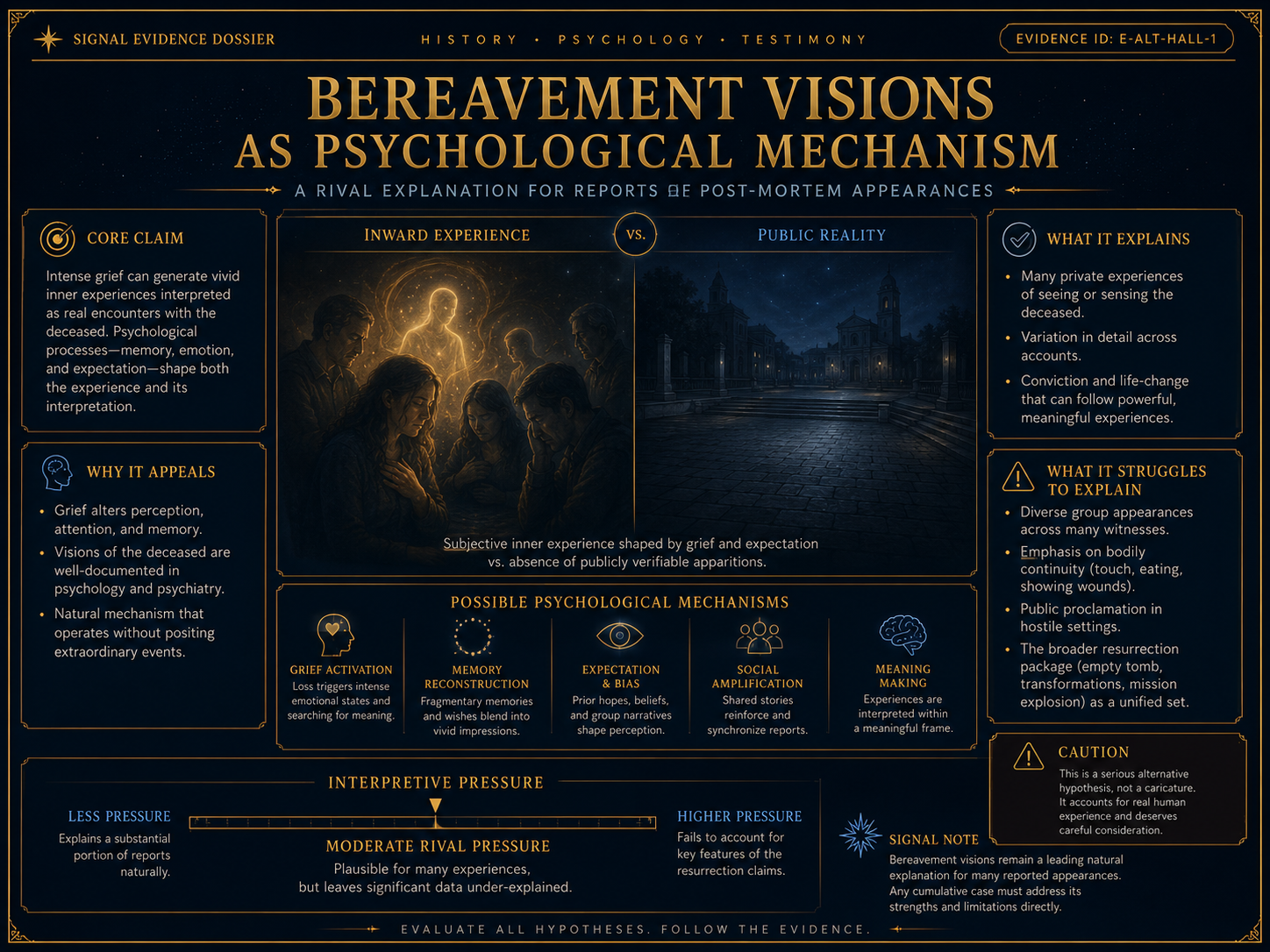
Primary Datum
Datum: Duplicate/context candidate under `E-ALT-HALL-2`; do not score independently until the hallucination-alternative cluster is reconciled.
Scoring / Hypothesis Pressure
Contextual / unweighted / no active Bayes factor.
Dependency / Cap Metadata
- dependency_cluster_id
- resurrection_alternative_explanations
- dependency_cluster_role
- context_summary
- dependency_cluster
- resurrection_alternative_explanations
- dependency_role
- context_summary
- cap_profile
- exact_duplicate
- evidence_function
- unweighted_explanatory
- directness
- explanatory_only
Counter-Pressure
- title
- Visionary mechanisms matter, but they must not be double-counted into certainty.
- text
- Bereavement visions are a real part of the rival explanation space. They help explain why grieving people may report powerful experiences. But this row is contextual: it keeps the mechanism visible without letting the same psychological explanation become multiple independent blows against Resurrection.
- path
- Use this as a map marker. Say plainly that grief and visionary experience are real. Then ask whether this mechanism explains only private consolation or also the full Resurrection pattern: public proclamation, bodily categories, empty-tomb claims, Paul, James, and worship. Keep the mechanism visible, but do not count it twice under different labels.
Apologetic Note
- label
- Rival-pressure use
- title
- This is unweighted context for the visionary-alternative lane.
- key point
- The row keeps bereavement-vision psychology visible without giving it a second score on top of the main hallucination/visionary alternative anchor.
- conversation move
- Use it as a reminder that the visionary hypothesis is not mere handwaving. Then keep scoring discipline by reading it under the active hallucination-alternative cluster rather than stacking it independently.
- caveat
- Because this is a duplicate/context candidate, it should not be treated as an additional active argument unless the cluster is later reconciled.
Caveats / Notes
- Cap notes
- This row preserves unweighted Resurrection-rival context and does not add independent BF on top of scored rows.
- Cap profile note
- Hidden/merged duplicate rows must not stack if reactivated without review.
- Cluster note
- Active legacy BFs cleared to prevent double-counting hallucination evidence already represented by E-ALT-HALL-2.
- Scoring note
- Active legacy BFs cleared during resurrection-cluster governance pass; keep outside independent scoring unless rewritten as distinct bereavement-vision evidence.
Machine-Readable Source
This page is generated from the public evidence mirror without recalculating or changing scores.